
We Look to the Future: A Reply to David E. Dean
At the outset, I want to express my gratitude to David Dean for his substantive entry into this debate. As much as we genuinely disagree, I respect him for not resorting to fear mongering or maligning the motives behind the proposals. I am likewise thankful for our conversation via Zoom which preceded the publication of his article; his charity in welcoming that conversation truly reflects Christ.
Response articles pose somewhat of a challenge. They have a tendency of becoming a bit pedantic, responding to each claim point by point. It can all become a bit long-winded.
I am going to take a different approach in responding to David E. Dean’s recent article that expresses opposition to the 2026 Declaration of Principles. I will briefly respond to some particular points at the end as a sort of appendix. More than this, I want to give you a context for thinking about these things. And eventually, I am going to invite you to step into my shoes, to look through the eyes of a 34 year old pastor, as we look to the future.
How Did We Get Here?
David provides a short synopsis of some recent history since 2017 which he says has led to the present proposal. While I trust this is an honest attempt on his part, I do not agree with the precise details he relates. From my position as ACGC Recording Secretary, serving my ninth and final year, I particularly disagree that there has been any official mandate at all concerning what changes might be made to the Declaration of Principles - the Triennial record is completely absent of anything like that. I don’t wish to nitpick any further here and I will only offer a bit more comment in the appendix.
I think his instinct to relate how we got here is spot on, but we must go further back and up (if you will), taking an air balloon view of our denomination’s history and practices.
When David says we have always been a noncreedalist denomination (“no creed but the Bible”), I think he is basically right. We reluctantly formed a denomination in 1860 and have presented ourselves as noncreedalists ever since. However, while we have been formally noncreedalist, we have functionally violated the principles of noncreedalism on a regular basis.
Think first of our churches. How many of our congregations grant membership to someone without ensuring that he or she embraces basic Christian beliefs? I would suspect the number is very few, because we understand it would be reckless to grant membership to just anyone who applies regardless of their beliefs.
Even among our conferences we can find an example of at least one that maintains a standard for membership. The Piedmont Conference states in Article I Section 2 of its bylaws, “A church making application for membership in the organization must state therein that it subscribes to the ‘Declaration of Principles’ of the Advent Christian General Conference of America.” It raises the question - if the Piedmont Conference maintains such a standard, what should prevent the General Conference from doing the same?
We encounter the same inconsistency when it comes to credentialing ministers. Just consider: how many ministerial committees strictly limit their assessment to only an examination of a candidate’s calling, Christian character, and embrace of biblical authority? While there is no uniform standard from one committee to another, the members of each committee inevitably compose and apply an informal doctrinal standard to each candidate.
Possible examples abound, but one will suffice: How many of our committees would ordain a minister who believes in salvation by works? I feel confident in saying none would. If this is the case, then noncreedalism comes tumbling down. The doctrine of salvation is an interpretation of Scripture - it is not the Bible itself. Where there is an exception, there is a standard now revealed.
I rejoice in this inconsistency because it has been the saving grace of our denomination. Our ministerial committees, even those including ardent noncreedalists, know better than to allow so much false teaching to enter into our churches at the cost of being consistent noncreedalists. Just as Communist China has ultimately embraced some capitalist principles, so have we embraced standards beneath the surface.
In his book Resurrection Hope, Dr. David A. Dean faithfully reported the noncreedalist conception of the DOP, particularly that it was not intended to act as a test of Christian fellowship in the local Advent Christian church. Even so, in the same space, Dr. Dean states that, “strict doctrinal standards have been set for those in the ministry and teachings positions.”(p.11) In keeping with what Dr. Dean describes, we have not proposed that the DOP be used as a test for local church membership; we have only proposed that there be a standard for denominational membership, applied only to pastors, churches, and other denominational organizations. While Dr. Dean implies that we have maintained such standards for Advent Christian ministers, I think we must admit that we have fallen short of what he describes.
While formally professing noncreedalism, our actions and statements reveal that we recognize it is functionally untenable to be consistent noncreedalists. We have kept hidden standards and have only refused to bring them out into the open to form a common standard. The result has been that in some places trinitarians have been refused ordination, while in others nontrinitarians are turned away. It has meant many applicants have been given credentials who do not believe in the sleep of the dead and the destruction of the wicked. It has meant the gradual deterioration of Advent Christian identity, a loss of unity and trust in Advent Christian pastors due to this inescapable variability in standards. It is variance not only across place (one conference to another) but also across time (one term of a ministerial committee to the next). The sum total is confusion - we don’t know who we are and we don’t know who we can trust.
This is the inevitable outcome of noncreedalism, even nominally held. To be clear, noncreedalism should be rejected because it is self-contradicting, because it inevitably results in hypocrisy, and because it reduces the Scriptures to a mere collection of words that lack any sure meaning. However, if that were not enough, noncreedalism should be rejected because it is literally the greatest threat to Advent Christian identity and to our safeguard of the Gospel message. I refuse to submit to the magisterium of our history when everything indicates that noncreedalism is a destructive error that should be left behind, no less than that old practice of date-setting. It is time to step into our future.
The Two Proposals
Bringing two proposals to the table is ambitious, but necessary. If we are to have standards of belief for denominational membership (think pastors and churches, not lay people), the bylaws need to be amended to indicate that. If those standards will include the Declaration of Principles, the DOP must accurately summarize our common understanding of the teaching of Scripture. Because the current DOP manifestly fails to do this (in fact because of the shifts noncreedalism has allowed) a new DOP is needed that accurately describes Advent Christian identity in the 21st century and that can serve as that standard. That is the short version of why both proposals are needed now.
If only the 2026 DOP is adopted, the integrity of our identity will continue to be corroded by noncreedalism. If we make the DOP a standard of membership but make no changes, most of us will fall short in some way and it will, in a manner of speaking, be false advertisement. If we don’t include the DOP and only require the Statement of Faith, we will eventually become an entirely generic evangelical denomination.
The 2026 DOP will not make everyone perfectly happy - we are too diverse for such a state of affairs. The wording was carefully chosen to be precise on essential matters and open-handed on secondary matters. Precision on the essentials - because we believe we must take great care in these areas. Open-handed on secondary matters - because our Adventist spirit suggests we can be flexible within the described limits of those matters specifically identified, as well as in so many other matters left unstated.
The 2026 DOP was intentionally written in such a way that it could serve as a standard of membership for the denomination. If the proposal was changed in ways that ignored that purpose, such that it could not serve as a standard of membership, all would be undone. To be crystal clear, the 2026 DOP will not serve as a uniform standard unless changes are also made to the bylaws, but the form it has taken is necessary to welcome that possibility.
Any negative feedback I have received usually arises from fundamental differences on essential doctrines or from a desire to narrow ourselves on the secondary doctrines. Making changes on essential matters (e.g. the doctrine of God) will only flip opposition from one side to another. Narrowing ourselves on secondary doctrines (e.g. final punishment), so that we might achieve an ideal conditionalist articulation will only exclude those we have continued to welcome who do not entirely embrace conditionalism. The noncreedalist has no need to worry about such things - he can create (or maintain as it were) a declaration that pleases him and that everyone else can ignore. This is an entirely different effort.
The 2026 DOP offers us a denominational border we should and can keep. It is not exhaustive, it does not say everything that could be said, but it does say what must be said. The affirmation/denial pattern is utilized to concisely drill down to those necessary things which encompass the otherwise broad theological landscape of the Advent Christian denomination. It gives a solid frame for our liberty, without which there is only anarchy and chaos. If you want more detail concerning the logic behind this frame, you can read my article, To Reckon and To Answer: God’s Call Upon Advent Christians.
Even in agreement, each person will have differing preferences for how we articulate our shared beliefs. When the proposal went through the review of the task force, I had to set aside some of my own preferences. I have gladly done so because of the obvious good that is presented in the 2026 DOP. As the saying goes, I would urge that every one of us not allow our personal idea of perfection to become the enemy of a substantial good.
Without a doubt, adopting the 2026 DOP as a standard will have ramifications for those who are already members of the denomination. For those who will continue to embrace nontrinitarianism, it will rightly bring to a head and eventually to a close their continued membership in the denomination. For those credentialed pastors who fall outside of the frame of the 2026 DOP, I have prepared a pending proposal that would ensure they would be grandfathered in, provided they can minimally affirm the Statement of Faith and our current Enduring Resolutions. If you have more questions about the proposed structural changes, I encourage you to see Nathaniel Bickford’s article here and the explanatory graphic he created, or my article comparing the proposal with Congregationalist practice. This is a time of transition calling for much grace; these changes are intended to have their greatest purchase for us moving forward into the future.
Through My Eyes
I am a member of the 3% - a figure that unfortunately does not reflect any great wealth on my part. I am 34 years old, placing me in the >34 age bracket that makes up only 3% of Advent Christian pastors. At the other end of the spectrum, nearly 60% of our pastors are over the age of 60. Based on the last report I received (and I praise their efforts), the Ministry Training Institute has 17 students, and not all of these are working towards pastoral ministry. I am not an economist, but there is a looming disparity here between supply and demand. We will need to bring in pastors from the outside if the pulpits will be filled.
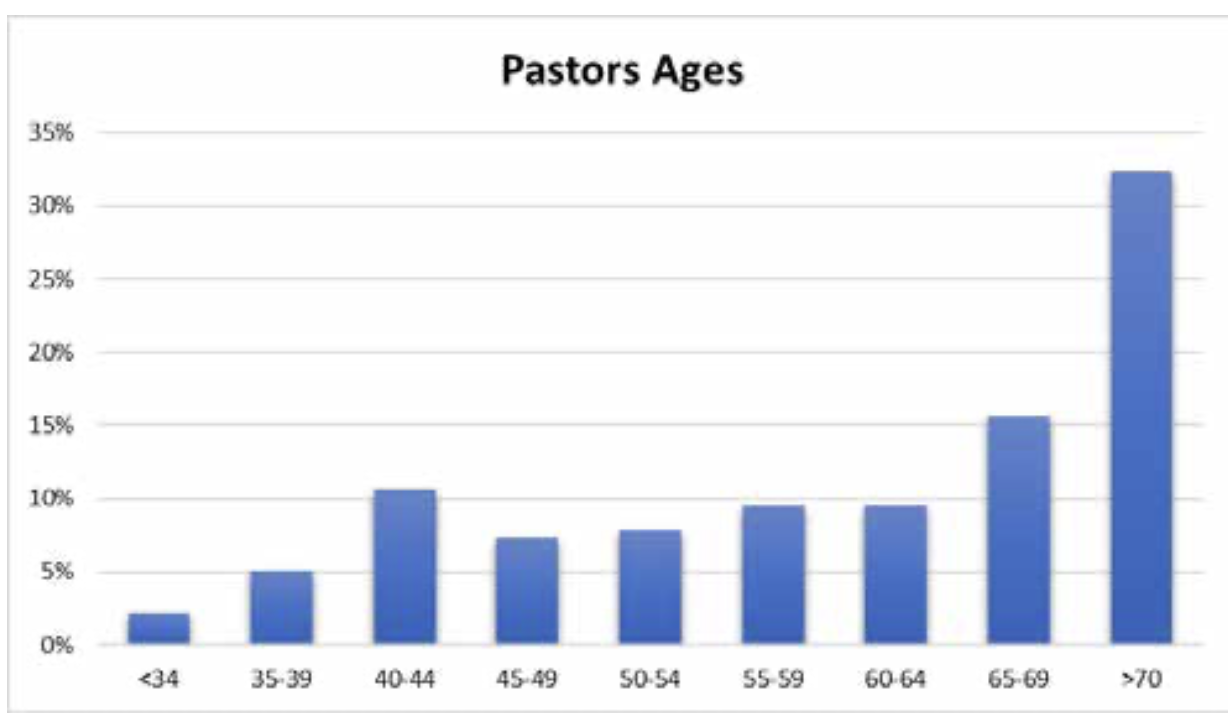
Graph produced by ACGC office (poor image quality due to being a screenshot)
Thinking about these pastors, and even thinking about those who are homegrown, we grapple with the obvious difficulties of assimilating them into our tradition. Most of the theological works by Advent Christians are no longer being published and their authors have entered their rest. I was one of the last to have the opportunity to study with Dr. Gordon Isaac at GCTS and to become acquainted with the Adventual Collection housed there under the guidance of its late curator, Duane Crabtree. Our collection remains, but there is no longer anyone there to guide.
What is an outside pastor to think then, and again, even our own, when Advent Christians no longer have any traditional academic institution, no longer have any professors, and no longer publish theological works? What is such a pastor to think when all we have is libraries filled with books and newspapers from a 100 years ago? That pastor might just think our theology is a dead tradition, a historical artifact. All the more, we can imagine a pastor thinking that when others say, again and again, that you can simply ignore our Declaration of Principles.
This concerns me. It is for this reason that I make no apology for this effort. I see where this is going: as a young pastor, I will be left with the remains of a dead denomination if we do nothing. This is all very uncomfortable, but I am not interested in hospice care. This is a call for resuscitation - the first step in reviving Advent Christian identity. That first step is declaring the identity of Advent Christians in the 21st century. No longer prisoners of our past, no longer musty, antiquarian curiosities, but a living body of believers who can declare without qualification, “I am an Advent Christian.”
I am not MLK, but I too have a dream. Building on this foundation, I dream of a future in which theological study and dialogue is alive and well among Advent Christians - a future filled with books, journal articles, professors, and growing educational institutions. I am looking forward to a future in which our churches are safeguarded and supplied with pastors, from within and without, who embrace our convictions. I am zealous to see this denomination prove that we can be both the home of evangelical conditionalism and the home of robust Christian orthodoxy on the essential matters of the faith - proving the two are not at all opposed. All the more, I dream that we will be the denomination that turns all believers towards the hope of Christ’s return and the promise of resurrection. The Gospel is poorer when a Christian’s hope is to die and go to heaven. Let us be the ones who emphasize that God is making all things new in Christ, that God will not abandon his good Creation, that only in Christ’s return is the Gospel fully told. AI will not save our planet, nor any of the tech bros - Jesus Christ is the Savior of the world.
This is the work we must be about. It begins in August.
Quickfire
With the above context in place and lest it be said I ignored any worthy critiques - here are my short responses to some of the points raised by David that I thought were most important.
“Revising” the DOP
David claims the bylaws amendment in 2023 was only intended to make provision for limited revisions to the DOP, not introducing a whole cloth replacement. I see nothing in the bylaws that indicates such a limit, the word “revise” not even appearing in the text. The prescribed procedure applies to “Any action which would effect change” of the DOP. While my research indicates that at least some Advent Christian authorities considered the 1900 DOP to be the first official DOP, it remains the case that an earlier 1881 DOP was entirely replaced by the 1900 version. It seems strange to me that a noncreedalist is suggesting that we must remain more or less wedded to the original form of the Declaration of Principles, a merely human text.
Dividing the Preamble and Principles
The preamble of the 2026 DOP has a threefold function: (1) It explains the expectations which have shaped the form of the 2026 DOP; (2) it clarifies that the DOP is not intended to establish a litmus test for local church membership; (3) and yes, it does provide coherent unity if the bylaws are changed to make the 2026 DOP a standard of denominational membership. On its own, the preamble of the 2026 DOP cannot establish itself as a standard of denominational membership. Without changes to the bylaws, it is merely a standard optionally provided, which anyone may freely accept or ignore. As pointed out above, the Piedmont Conference is an example of a conference that has already done that very thing with the current DOP, requiring that new churches affirm that they subscribe to the DOP. If the preamble is separated and removed from the rest of the proposal, its internal logic will be lost and lay people will be left in the confusion that already presides, in which they are led to think they must agree with the DOP to join a local Advent Christian church. I understand why David opposes the preamble as a noncreedalist, and he is right that it might increase the number of those who are opposed to the 2026 DOP. Nonetheless, I think we must consider the proposal as it stands, as a united whole.
Working through each principle would invite a litany of amendments that would in like manner threaten to break the unity of the proposal. Besides this, it would quite probably filibuster our consideration of these important proposals. Before bringing this proposal to the Executive Council, I welcomed a great deal of input from Advent Christian leaders during the summer of 2025, gaining the endorsement of four conference boards and the board of the Eastern Region. In September 2025, I published the original version of the 2026 DOP and it was known that it was being sent on to the task force. Why were considerations and concerns not communicated at that time? The bylaws have outlined a process that entails a task force so that careful and holistic consideration may be given to the proposal, thereby avoiding a battle of competing interests on a convention floor that would tear all sense of coherency to shreds. Take it or leave it, I welcome the decision of the delegates on the proposal as it stands.Principle II - “Teachings”
I am perplexed by David’s disagreement with principle II. In short, the principle affirms that as far as we can know the meaning of Scripture, we should hold that teaching as authoritative; that is what is meant by “teachings.” Now either David has misunderstood the principle as meaning teachings that go beyond what is communicated in Scripture or he is denying that we can actually know what the Scriptures teach. The latter would be consistent with noncreedalism and a reminder of the radical consequences of that ideology: it leaves us with a Bible that has no meaning, a mere collection of words that may be rearranged like legos according to anyone’s pleasure.
Principle X - “Congregational Involvement”
David seems to read the phrase, “congregational involvement” as indicating a move away from congregationalism. In fact, that is not the case. That framing was carefully chosen to encompass the full spectrum of congregationalism practiced among our churches. It is an area of intentional open-handedness. To narrow the framing to one particular manifestation of congregationalism would unnecessarily exclude some of our churches. The General Conference recognizes the liberty of our churches in this regard by adopting this framing.
Less Detail on the Father and Spirit
I can agree with David that some more detail could be offered on the Father and Spirit, particularly on the Father. However, in working with the task force it became clear that there was concern about the accumulation of too much detail. In all of these things, more might be said. In that case we might end up with quite a lengthy DOP, which would make it more of a confession than a declaration of principles. We have tried to say those things that are absolutely necessary and which will guide us moving forward. With this in mind, I believe we should adopt the proposal as it has been presented. Again, I think it would be shortsighted for any of us to allow our personal vision of perfection to become the enemy of a very significant good.
Salvation
He claims that a concise statement on salvation is lacking. However, a careful reader will notice that it is integrated with principle V which also deals with the question of human immortality. Is this not in fact an excellent place to position our statement on salvation as Advent Christians? Consider the comparison and see if it is lacking:
Current:
“We believe that salvation is free to all those who, in this life and in this age, accept it on the conditions imposed, which conditions are simple and inflexible, namely, turning from sin, repentance toward God, faith in the Lord Jesus Christ, and a life of consecration to the service of God; thus excluding all hope of a future probation, or of universal salvation.”2026 DOP:
“We affirm that God alone is immortal; that God created human beings as creatures with mortal natures who could yet receive and enjoy eternal life with God; that through sin they forfeited this divine birthright; and that because of sin they can only be restored to life with God by grace alone through faith alone in Jesus Christ alone, resulting in a life of repentance from sin and consecration to the Lord.
We deny that human beings are inherently immortal or that God could be compelled to maintain human existence in opposition to his divine will.”The Denials
The point of the denials is not to anathematize. Yes, in many instances they cut against false teachings, but the point is to present a concise understanding of our beliefs. If this might be misunderstood elsewhere, it can be clearly seen in the case of principles X (Church) and XIV (Human Government).
“We deny that the liberties and prerogatives of the local church would preclude cooperation with a denominational body in maintaining such freely agreed-upon standards of membership.”“We deny that every war is just or that anyone should be compelled to take up arms in violation of their conscience.”
I will let my video found here be my response on this point for those concerned with the phrase “eternally begotten.” It is very strange to me that Advent Christians who embrace terminology like “conditional immortality” protest so much about employing similar terminology to describe other biblical truths. These terms are used to explain what the Scriptures say - if we strictly limit ourselves to “Bible words” we will only offer a rehearsal of the text, not an explanation. It is widely recognized that to define a word you cannot use the same word in your definition. We must remember the same here.
Principle V and IX - “Eternal life with God”
Recall that the framing purpose of this DOP is to provide a defining standard of Advent Christian belief in the 21st century. Given that we continue, and rightly seem content to continue, giving credentials to pastors who disagree with us on annihilation, we must use language that can be affirmed by those who believe in eternal torment and by those who believe in annihilation. Make no mistake - I am an ardent annihilationist and I want our convictions to win the field; if we will get off our haunches I’m confident we will persuade many. This proposal, paired with the proposed enduring resolution , will ensure we have a friendly audience among us..
Principle VII - “that the belief in the sleep of the dead, historically held by Advent Christians, is within sound biblical reason”
This was a statement the task force wanted to see included. Why? Because this is another area in which we have become open-handed. Not every Advent Christian believes in the sleep of the dead. I was prepared to make this an area of silence, but they wanted to include this detail to ensure that this doctrine did not fall out of view. I understand their desire and support this statement.
Afterword
Reader, if I missed a critique that seems important to you, please raise it and I will address it. I never expected this proposal would be perfect in the eyes of all - such an expectation is unrealistic. Could the proposal be improved? Perhaps. Remember, I too have had to make compromises in this process. I never could have moved this proposal forward if I had insisted on my own way all the time. Repeating myself once more, I plead that you not pursue perfection at the expense of a great good (thus resulting in neither). If we fail to move forward at this time, it will be a great loss.
David is correct that much work has gone into this effort. Many people, many conversations, and yes an enormous investment of time and energy on my part. If you see weaknesses, but can support the proposal, then I urge you to do so. As I have clearly indicated here, the DOP is not a document which stands beyond improvement. At some point, maybe you will be the one who will address any remaining weaknesses and make us stronger yet.
As for myself, I am doing my utmost to see that we will have a future in which our weaknesses can continue to be transformed into strengths. We must all look to the future. We have no home in the past. The Master approaches. How will he find us?
