
Unifying Islands · or · Why I Support the 2026 DOP
Rev. Matt Rice is the pastor of Dulin’s Grove Advent Christian Church in Charlotte, NC.
When my wife and I moved to North Carolina we entered uncharted territory. It was a new environment, a new culture, and even new pastors and churches that were mostly unknown. After all, I had spent the majority of my life in one Advent Christian church where my dad was my pastor. Moving states and entering ministry (all in 2020, mind you) was a big jump. When we had some time, we journeyed down to Wilmington, NC to enjoy the beach. As we explored the city, we drove by an Advent Christian church and it dawned on me that there was another located nearby. It was in that moment, though, that I realized the importance of a name.
I had never been to those churches, and I didn’t yet know their pastors. Though I knew that those churches were Advent Christian in name, I realized I could not say anything definitively about what those churches believed or preached. Having grown up in an Advent Christian church and attended various campgrounds and campmeetings in New England, I took this for granted. I assumed that all Advent Christians just shared unifying beliefs. Yet as I entered into ministry and began working with other pastors and churches, the differences of opinion and doctrine emerged. Wilmington was where I encountered the lack of clarity surrounding what Advent Christians believed and it startled me.
A Familiar Past
The seminal work of Dr. David A. Dean in Resurrection: His and Ours corroborates this ambiguity in knowing what Advent Christian churches, or Advent Christians themselves, believe. Dr. Dean, in this work which defines and expounds upon the current Declaration of Principles (written in 1900 and amended in 1964 and 1972), is adamant that these beliefs are “not a creed, to which all must subscribe in every detail.”[1] Instead, they are brief and general summaries of what many Advent Christians believe. It’s interesting, then, that Dr. Dean quotes an article from the World’s Crisis, written by James A. Nichols Jr., to describe the Declaration of Principles as “merely descriptive of what most Advent Christians believed at the time when they were formulated.”[2] What then, is the purpose of these Declaration of Principles? Dr. Dean elaborates on one purpose while hinting at another.
The Advent Christian Declaration of Principles are intended to be summary statements about general beliefs that Advent Christians uphold. That answer might seem vague, because it needs to be. According to Dr. Dean, “We shall try to remember as we enter the study that the declaration is not binding upon individual Advent Christians and we shall try to extend charity toward any who for reason of conscience disagree with any of its statements.”[3] That charity is extended only inasmuch as one can make a biblical defense for their belief. Yet Dr. Dean hints at a further restrictive usage of the Declaration of Principles as they relate to the “strict doctrinal standards [which] have been set for those in the ministry and teaching positions.”[4] Though Dr. Dean does not mention those standards explicitly, it seems as though there are beliefs which serve as a standard for those entrusted with teaching positions across the denomination.
The question of the DoP’s purpose remains ambiguous at best and at worst, unanswered. Are they a binding set of beliefs that churches and ministers must uphold? Or are they general summary statements that capture what many Advent Christians believe? Whatever answer you prefer, the lack of clarity is troubling. What do Advent Christians believe? Who are we? And more importantly, how are we working together to further God’s Kingdom and anticipate and await the second coming of Jesus Christ?
A Troubled Present
The 2023 Triennial was the first I was able to attend since entering ministry. While I did attend as a young boy, I won’t count running around the various venues and taking the spoils from different booths as full participation. The 2023 Triennial included a question that first surfaced in a 2021 article written by Nathaniel Bickford: Do we need to consolidate our denominational structure to promote more effective Kingdom work? His answer, yes. Tom Loghry echoed his sentiment with a more pointed question: “We can change, but will we?” These two younger pastors advocated for their position on a panel alongside seasoned Advent Christian pastors and leaders. It was there, once again, that the question of Advent Christian identity surfaced.
Advent Christian Voices has served as the forum for discussing various topics, changes, and ideas among Advent Christians. It was the hub for the aforementioned articles (and many others!) which fueled discourse at the 2023 Triennial and it serves a similar purpose today. Nathaniel and Tom have contributed articles there for many years now, advocating for ideas they believe to be worthwhile and helpful for the Advent Christian denomination. It should be no surprise, then, to see their names attached to suggested changes to our structure. They have not only put the ideas forward, but have given time and energy to make these ideas a reality. Their articles have made their intentions clear, and while there is room to disagree with their proposed changes, their motives are honorable and actions above reproach.
As Tom wrote, and wrote publicly, he arrived at a pivotal juncture in April of 2024. Tom first noted that there exists an awkward balance in our identity: are we a collective group of churches or are we the Advent Christian Church? His follow-up article outlined suggestions for rewriting the Declaration of Principles. His rationale reflects an updated take on James A. Nichols’s suggestions (as quoted from the World’s Crisis above) for the DoP in the first place: “Our beliefs would then reflect our priorities – our commitment to the broad and orthodox fellowship of our local churches, setting forth Christian unity, and our dedication to proclaiming the Gospel ahead of Christ’s return.” This notion took time but eventually grew into the 2026 DoP, a history Tom graciously outlines there.
This document has undergone revisions at the hands of a task force appointed by the Executive Council, per our constitution. Perhaps the single most contested sentence of that document is found in the preamble, something Tom did not write. It reads, “The Advent Christian Declaration of Principles is intended to provide a clear standard for membership in the denomination among regions, conferences, churches, and ministers.” Though the idea of a standard imposed on the various denominational levels has raised the alarm of some, it reflects exactly what Dr. Dean wrote was already in place in 1977.
Much ink has been spilled in the recent past about the new proposed Declaration of Principles. One has only to read the articles and positions offered on ACV or Facebook to see the fault lines that exist in our denomination. There are those in favor, those opposed, and still many voices of Advent Christians who have remained publicly silent on the matter. I have been silent myself. I hope to remedy my silence and would encourage you, those silent voices, the unspoken opinions, to consider why I support the 2026 Declaration of Principles and you should too.
A New Proposal
Today, only a name truly unites the 229 Advent Christian Churches across North America. I don’t say this to get a rise out of some, but to merely echo the fact that we have an identity problem among our churches. Turns out, this identity problem has existed since our inception. Clyde Hewitt, historian of the Advent Christian movement and its coalition into a denomination, explains: “The Millerite movement gathered into its ranks believers from nearly every Protestant denomination of the day. They were united, and rejoiced in each other’s company, on the one belief that mattered – the soon coming of Christ. In this blessed hope individual doctrinal differences were rarely, if ever, mentioned.”[5] An entire denominational structure with churches, conferences, regions, and positions in the general conference, was built upon a tenuous practice of agreeing not to speak about what we disagreed on.
As we look to the future, I dream of a day when Advent Christian churches are clear on the fundamental beliefs of the faith and state those doctrines which unite them. In what follows, I’ll outline why I support the proposed 2026 Declaration of Principles.
The proposed changes are unashamedly trinitarian in the most Advent Christian way. For starters, the word ‘Trinity’ is absent from the document. This borrows the practice of only using scripture to define what we believe, which principle three does perfectly. This stance is lacking in the current Declaration of Principles. Dr. Dean admits that our current Declaration of Principles failed to rise to this level: “it is equally clear that the declaration’s content falls far short of an adequate expression of trinitarian theology…. The content of the Declaration is not trinitarian; it omits too much.”[6] Differences of opinion on who God is, or what the Bible teaches about Him, result in a different religion.
Christ is exalted and emphasized as being fully God and fully man and thus is the only source of salvation through His willing sacrifice upon the cross. Principles 4, 6 and 8 stress this truth. Principle 8 also rekindles a fervor and an excitement that Jesus is coming soon – something Advent Christians have historically and consistently emphasized.
The proposed suggestions are unashamedly Advent Christian! The biblical case for immortality belonging to God alone is stated in principle 5. The condition of death as a sleep until Christ’s return is principle 7. The imminent return of Christ is principle 8. The judgment of God coming only after Christ’s second coming is principle 9. The required readiness of all Christians results in principle 13. These are hallmark truths for Advent Christians, and ones we should continue to emphasize!
The second principle of the document emphasizes the clarity of Scripture without forcing conformity to non-primary truths. Principle two denies “that Christians must agree on every matter of the faith to share in one fellowship.” This is imperative! The aspects of faith that are essential – those pertaining to the one God eternally existent as Father, Son, and Holy Spirit - are “set forth clearly in scripture, and that, as far as the meaning of the text can be understood, Christians should seek to be of one mind in the Spirit and uphold such teachings as authoritative.” The juxtaposition of principles 2 and 3 is no mistake.
And yet, the aspects of the faith that are not essential are given room. There is no stance taken on many ecclesiological matters outside of their biblical existence and reference. Principle 10 affirms what Scripture teaches by placing the individual structure of the local church under Christ’s authority. A church’s leadership or those who compose that leadership are not prescribed in the 2026 DoP. If they were, I would not support the proposed changes. Instead, the 2026 DoP gives the priority and privilege of church structure to the local church. Yet this priority and privilege are not reasons for churches to lack involvement or cooperation in denominational efforts. In sum, all Advent Christian churches should participate in denominational life and maintain what Advent Christians have declared to be representative of themselves.
I support the proposed changes outlined in the 2026 Declaration of Principles because they clarify who an Advent Christian is and what we believe based upon the biblical witness. What we have currently is in desperate need of updating. The time and effort that many have put into this document demonstrates a collective effort. The adoption of this proposal is just the start of a groundswell movement that unites our churches and lives in anticipation of Christ’s soon return.
Bridging Islands: Dreaming of a United Future
At present, Advent Christian Churches are islands. We are autonomous, self-sufficient, and generally working towards bettering our local position. Even in the places where Advent Christian churches are in close geographic proximity there is little interdependence among those churches. There are some conferences that foster togetherness through joint sings and I’ve been blessed to participate in book studies in my local Piedmont Conference. But what of joint church efforts who partner for the sake of the gospel and the Kingdom of God?
2024 gave Advent Christians a glimpse of united, kingdom work. Northside Community Church partnered with the struggling Mt. Pleasant Advent Christian Church to replant it. Northside provided funds, seed families, even the pastor from its own staff, to see the Kingdom of God proclaimed and furthered outside their own walls. It took unity of mind and vision and was built upon agreed truths. But the support included all levels of our denomination: the conference, the region, and even ACGC supported, guided, and prayed for this replant. The result was Redemption Community Church which is thriving!
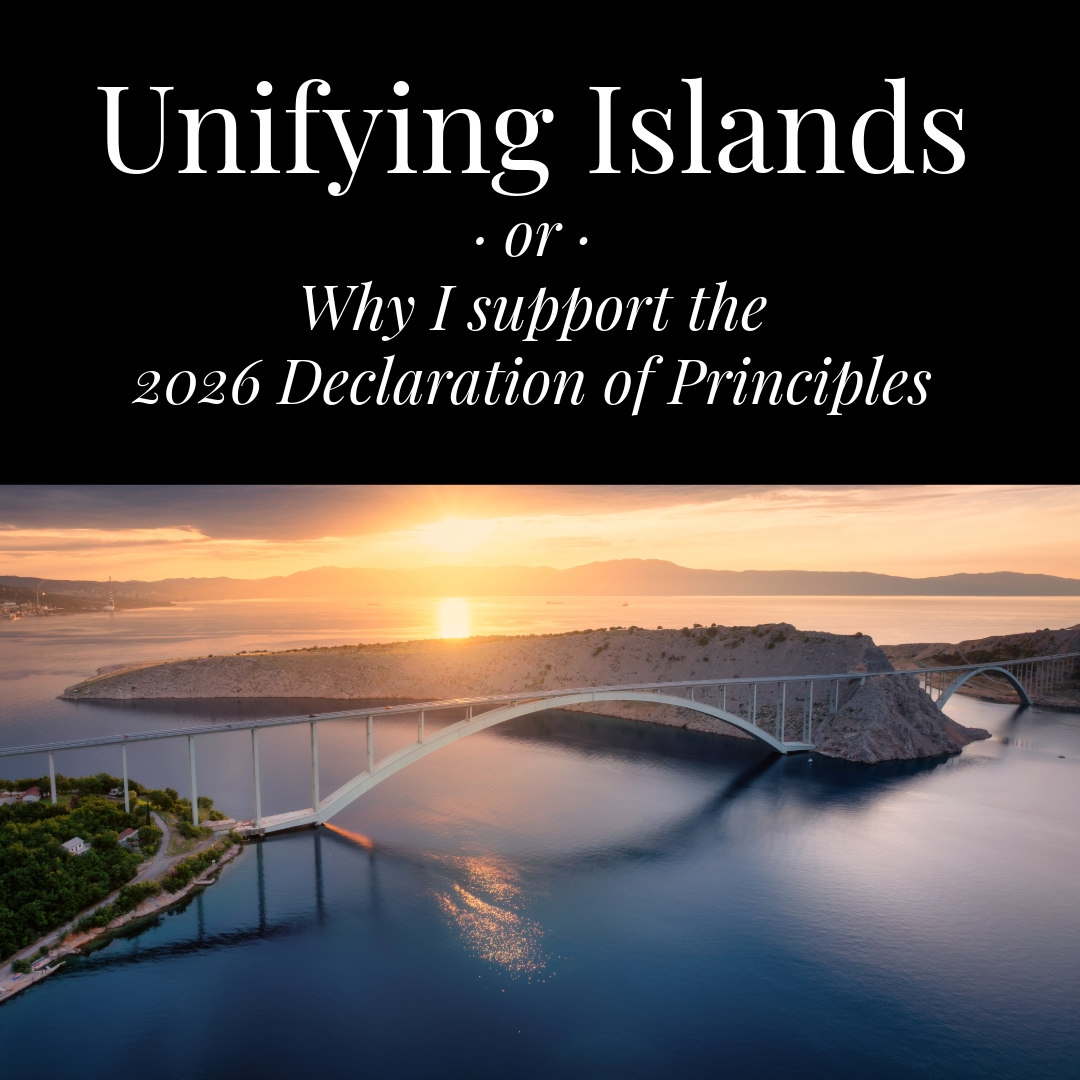
The 2026 Declaration of Principles provides a firm biblical and doctrinal foundation. I believe the changes provide a concrete base, the driven piles that reach to the bedrock beneath the water, that allows churches to build bridges between their respective islands. However, these joint efforts are not automatic and require prayer and communication as churches do the hard work of finding ways and opportunities to jointly proclaim that Jesus is Lord. Unity in our denomination will only come when churches partner together behind a shared cause and concern. Consider the amount of churches that partnered with and prayed for the replant of Redemption Community Church in Clayton. What would it look like for Advent Christian Churches to truly support one another and give fully of ourselves to further God’s Kingdom across our denomination? Let me offer three examples:
Church A sends a team of volunteers with decorations and necessary supplies to put on a VBS at Church B (who can’t afford or staff an event like this on their own). The one-day event takes months of planning but draws families and even leads a child to Christ! Church A goes home rejoicing at God’s work and Church B gains a family – something they’ve been missing for years!
Church C is going through a difficult time and needs help revitalizing its people. Church D agrees to partner financially, spiritually, and physically by helping to redevelop Church C’s outdated facilities. They also pray for Church C and all its members. They also prayerfully provide coverage for services for one month so that Church C’s leadership can refocus their efforts and pursue change.
Church E has been without a pastor for several months and has had no successful candidates apply for its position. Church E has no parsonage and is unable to provide an adequate salary to employ a full-time pastor or attract a bi-vocational one, yet Church E is the only Evangelical Church in the area. Churches F, G, H, and I, all part of Church E’s conference, agree to raise funds to subsidize a pastor’s salary for two years. These churches supplement $50,000 to see the gospel proclaimed and Church E flourish, without receiving anything in return.
Advent Christian Churches need mutual accountability and unity. But for our churches to work together, we must first agree upon the identity that we claim to share as Advent Christians. As the pastor of Dulin’s Grove Advent Christian Church, I must be able to say with certainty what another Advent Christian Church believes or holds as true before I can commit the flock entrusted to my care to another cause. As an Advent Christian, I’d love to know who we are and what our churches believe so that I can unequivocally recommend ANY Advent Christian church with full confidence without knowing them or their pastor personally. We must clarify our identity and shared purpose. I believe the proposed 2026 Declaration of Principles does just that.
If you disagree with me or have questions about what I’ve written, I’d love to talk more. You can reach me via email at mrice@mtiprogram.com
[1] Dean, Resurrection: His and Ours (Charlotte, NC: Advent Christian General Conference of America, Inc, 1977), p. 16.
[2] David A. Dean, Resurrection: His and Ours, p. 16. Dean cites James A. Nichols, “Denominationalism and Unity” World’s Crisis (June 14, 1950), p. 4
[3] Dean, Resurrection: His and Ours, p.17.
[4] Dean, Resurrection: His and Ours, p. 15.
[5] Hewitt, Responsibility and Response (Charlotte, NC: Venture Books, 1986), p. 16
[6] Dean, “The Trinity in Advent Christian History” in Alpha & Omega: Essays in Honor of James A. Nichols Jr. eds. Caroleen Hillriegal, Lois Jones, Freeman Barton (Lenox, MA: Henceforth Publications, 1980), 43. Emphasis added.