
God's Power to Save - Rev. Doug Foss
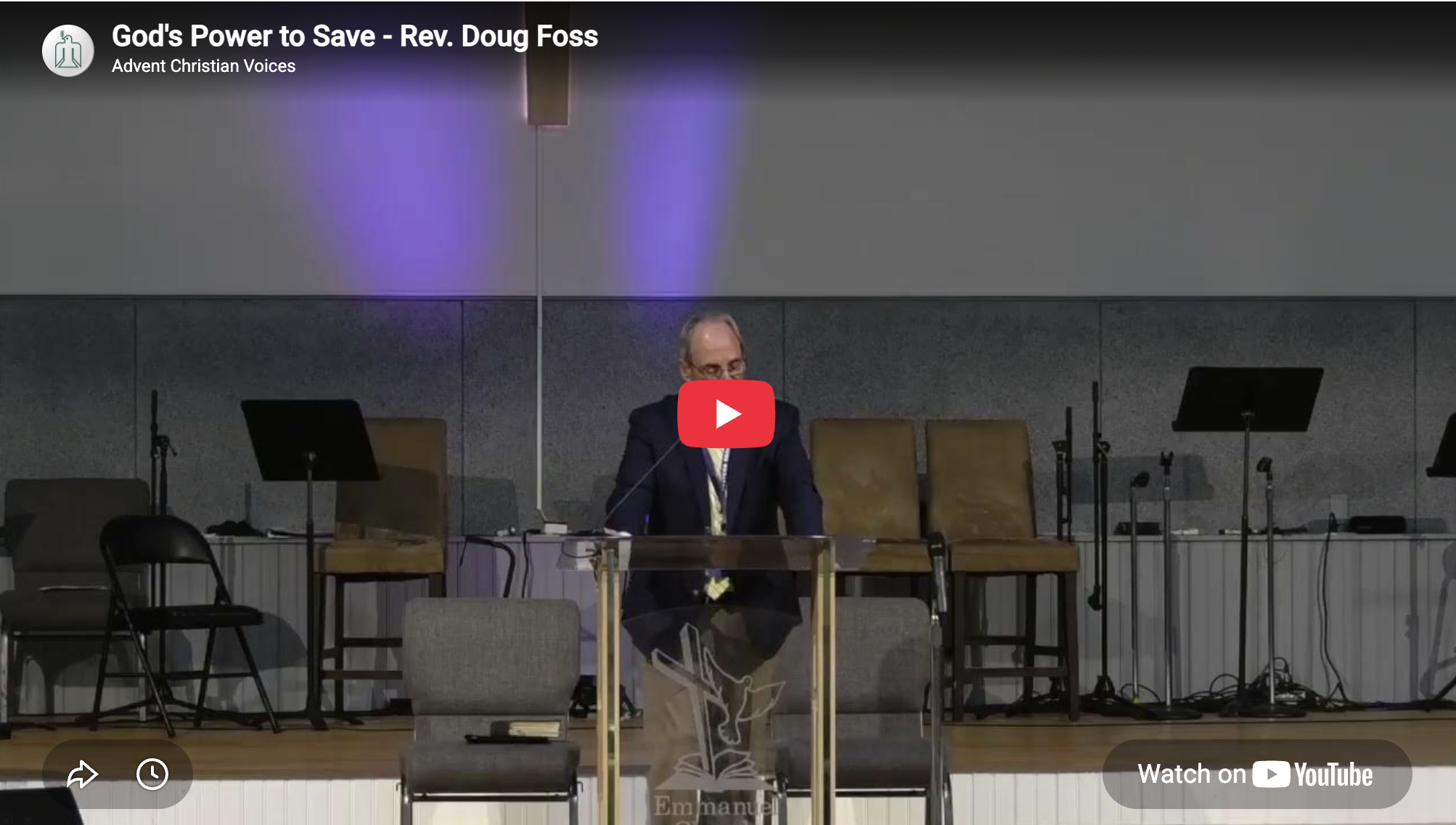
This message was given at the 2026 Annual Convention of the Advent Christian Eastern Regional Association. Rev. Doug Foss exegetes Ephesians 1, meditating on God's work of election and his saving power in the life of the Christian. The following transcription was generated by AI — any question of accuracy should be checked against the video.
Good morning everyone. Good to see you all. I think I appreciate the opportunity, Lou. I don't know. We're going to find out. This is quite a thing. And I really do appreciate being here and having an opportunity to share with you out of Ephesians chapter 1 this morning. And I've been assigned this chapter by the committee and I have to tell you that years ago back in the 1990s I preached through the book of Ephesians at Hope Church and it took me six months to get through chapter 1.
We're going to do this in an hour. Okay. So here we go. Right. I'm not kidding when I say that. It's a challenge, but we're going to try to meet the challenge this morning. I want to begin by suggesting that we open up to Ephesians 1. And what I'd like to do, I'd like to read that entire chapter. And I do think the speakers after me are going to read the entire chapter 2, 3, 4 as well. So Ephesians chapter 1, this is what we want to take a look at here for the next few moments.
And at Hope Church, we have a tradition of standing as we hear the word being read every Sunday morning as an act of reverence and really an act of worship before God as we hear his infallible and inerrant word read. And remember now, there was a time in the history of Israel they stood for eight hours at a time to hear the word read. I'm asking for three minutes. Okay? Thank you very much. All right. Ephesians 1.
Paul, an apostle of Christ Jesus by the will of God. To the saints who are at Ephesus and who are faithful in Christ Jesus.
Grace to you and peace from God our Father and the Lord Jesus Christ. Blessed be the God and Father of our Lord Jesus Christ who has blessed us with every spiritual blessing in the heavenly places in Christ. Just as he chose us in him before the foundation of the world to be holy and blameless before him. In love he predestined us to adoption as sons through Jesus Christ to himself according to the kind intention of his will to the praise of the glory of his grace which he freely bestowed upon us in the beloved. In him we have redemption through his blood, the forgiveness of our trespasses according to the riches of his grace which he lavished upon us.
What a word.
In all wisdom and insight he made known to us the mystery of his will according to his kind intention which he purposed in him with a view to an administration suitable to the fullness of the time. That is the summing up of all things in Christ: things in the heavens and things upon the earth. In him also we have obtained an inheritance, having been predestined according to his purpose, who works all things after the counsel of his will. To the end that we who were the first to hope in Christ should be to the praise of his glory.
In him you also after listening to the message of truth the gospel of your salvation having also believed you were sealed in him with the Holy Spirit of promise who is given as a pledge of our inheritance with a view to the redemption of God's own possession to the praise of his glory. For this reason I too having heard of your faith in the Lord Jesus which exists among you and your love for all the saints do not cease giving thanks for you while making mention of you in my prayers.
Now, 17, 18, 19—hang on to this. We’re going to start there this morning:
that the God of our Lord Jesus Christ the Father of glory may give to you a spirit of wisdom and of revelation in the knowledge of him and I pray that the eyes of your heart may be enlightened so that you may know what is the hope of his calling what are the riches of the glory of his inheritance in the saints and what is the surpassing greatness of his power toward us who believe.
These are in accordance with the working of the strength of his might which he brought about in Christ when he raised him from the dead and seated him at his right hand in the heavenly places. Far above all rule and authority and power and dominion and every name that is named, not only in this age, but also in the age to come. And he put all things in subjection under his feet, and gave him as head over all things to the church, which is his body, the fullness of him who fills all in all.
There is a tremendous amount of good stuff right there in chapter one and we're going to try to get through this now. So, as we attempt to grasp the theme of chapter 1 here, we have to begin by carefully noticing the prayer that Paul offers as he brings this chapter to a conclusion. He prays in verses 17-19
that the God of our Lord Jesus Christ, the Father of glory, may give to you a spirit of wisdom and of revelation in the knowledge of him. I pray that the eyes of your heart may be enlightened so that you may know what is the hope of his calling, what are the riches of the glory of his inheritance in the saints, and what is the surpassing greatness of his power toward us who believe.
Now, what would inspire the apostle to offer up this prayer? Well, it's uttered after the profound litany of blessings that have been accrued to the church of Jesus Christ that are outlined and expanded upon in verses 3–14. In these verses, Paul has laid out in a direct and unmistakable fashion the nature of the hope of God's calling and the riches of the glory of God's saints that they have inherited and the surpassing greatness of his power and favor toward us who have believed. So Paul prays for the believer that the Father may give us a spirit of wisdom and of revelation in the knowledge of him.
Now why does he do that? Because what Paul has just outlined in the first 14 verses cannot be properly understood. It cannot be appreciated or embraced apart from a spirit of wisdom and revelation. It is humanly impossible to grasp the meaning, the significance and the beauty of verses 3 through 14. As Paul states in verse three, God has blessed us with every spiritual blessing in the heavenly places. Not some, not most, every spiritual blessing in the heavenly places. And then in the next 11 verses, he enumerates these blessings one by one and reveals by them a unique gospel brought to bear upon the church of the triune God.
I appreciated the song set this morning, focusing on the Trinity. In fact, each person within the Godhead has a specific role that they assume in making sure that God has a people for his own possession that he has loved from before time and will love throughout eternity. And to understand the utter perfection and beauty and we say excellence and the mystery of God's role in dealing with us with this kind of a gospel will most definitely require a supernatural endowment of wisdom and revelation from above because it's not your typical gospel.
Because of the fallen human condition, God's plan for redemption is unknowable. It is unattractive and it is even repulsive apart from a spirit of wisdom and revelation. We're familiar with 1 Corinthians chapter 1 verse 23 where Paul says, "But we preach Christ crucified to Jews a stumbling block to Gentiles foolishness." The Jews stumbled all over the Trinitarian gospel that's presented here in Ephesians 1. And the Gentiles think it's utter foolishness. And by the way, that Greek word for foolishness is moronic. And you can hear the word there. That's what the world thinks of our gospel.
They think it's foolishness. Well, if that's the case, who grasps the beauty of God's gospel here? Well, in 1 Corinthians 1:24, the next verse, Paul says this, "But to the called, both from Jews and Greeks, Christ is the power of God and the wisdom of God." Who understands and embraces the gospel here? Only those who are called from among both Jew and Gentile. Only those who have been given a supernatural endowment of wisdom and revelation from above. And I hope to show that as we go through this chapter. So what I hope to demonstrate among other things this morning is the role each person of the Godhead assumes in our redemption and that we the bride of Christ would grow in our appreciation of God's plan and his design of saving a people according to his own purpose.
Now it's evident from the text that the Father, the Son, and the Holy Spirit each assume a certain and necessary role in our salvation without which none of us will ever come to Christ. In fact, we will immediately notice in verses 3-6 that those who have placed their faith in Jesus have done so because they've been chosen by the Father. That's followed by verses 7–12 highlighting that our election is not without cost. No, we have been redeemed by the Son. And that's followed by verses 13 and 14 describing the application of redemption being sealed with the Holy Spirit for the day of redemption.
Therein people lies our salvation and the gospel that God has ordained. And I trust that you notice that we have nothing to do with it. Absolutely nothing to do with it. And in presenting all of this, in addition, Paul rattles off one profound blessing after another as he describes the activity of God in redeeming a people for his own possession and then guaranteeing them an inheritance. So the Trinitarian gospel is the biblical gospel where the Father, the Son and the Holy Spirit are intricately involved in bringing about our redemption. And how are they involved?
Now this is where we have to get ready because the great apostle Paul describes the details of God's plan of salvation by employing terms and designations which radiate the surpassing greatness of his power—terms which reveal the hope of his calling and terms which highlight the abundant riches of the glory of his inheritance. Terms like election, predestination, adoption, redemption, forgiveness, revelation, the mystery of his will, inheritance, and the sealing of the Holy Spirit, just to mention a few. So why does Paul pray that the eyes of our hearts might be opened and enlightened? Because the doctrines of election and predestination and adoption and redemption and forgiveness and revelation and inheritance and being sealed in the Holy Spirit requires a supernatural intervention if we're going to grasp the meaning of this authentic gospel as described in these terms and then to embrace the profound nature of God's activity in bringing to himself a people for his own possession that he has set his affection upon before all eternity.
That is the glorious gospel because it's all of God. We have nothing to do with this. And what I find fascinating as we look at the activity of God in terms such as election and predestination and calling and the revelation of the mystery of his will and so on is that these terms are meant to bring comfort to the believer. And yet it's been my experience that these terms seem to breed hostility and even anger among Christians resulting in divisions. These very doctrinal issues many are threatened by and even refuse to consider are the very teaching that Paul assumes as basic, foundational, and fundamental to a Christian worldview and a proper understanding of the Christian faith and the Trinitarian gospel.
Now for sure we get it. Some of these statements recorded in the first 14 verses, they may at first glance be disturbing and at least complex. However, once understood in their proper context, they reveal a perspective of the God of the Bible which runs contrary to the God of contemporary Christianity. I hear people tell me all the time, and you've heard it, don't give us doctrine. Don't give me doctrine. Just give me the Bible. Or, you know, doctrine divides. We've got to be careful what we say. Now may I suggest to us this morning that one cannot know God.
One cannot come to faith. One cannot enjoy the Christian life apart from doctrine. Everything we believe is doctrine. The statement isn't don't give me doctrine. The question is what is the doctrine that you and I already embrace? Is it false doctrine? Is it heresy? Or is it orthodox? Is it truth? And secondly, of course, doctrine divides. That's what it's supposed to do. Doctrine always divides. That's a good thing for it separates the lie from the truth. And we should always battle for the truth. Yes, we sacrifice unity for the sake of truth. Absolutely.
Now, we're going to look at some doctrine here in just a moment that has unfortunately resulted in division when in fact it should result in comfort and doxology. And may I say, this does not originate with me. I don't know where I heard this, but it's right on the money. All sound doctrine, all sound theology begins and ends with doxology. This is exactly what you see in Ephesians 1. Ephesians 1 is concerned to present some of the most comforting and glorious doctrine and theology in all of the Bible. And if we come away from Ephesians 1 with anything but doxology, we have completely misunderstood the wisdom of God in sovereignly redeeming a people by his grace.
We've missed it. So let me begin by suggesting that if God would be pleased to give us a spirit of wisdom and of revelation in the knowledge of him. If he would be pleased to enlighten our eyes, the eyes of our heart, then the impact of God's dealing with us in this manner will evidence itself in three glorious ways. First, we will be enlightened with a fresh and deeper understanding and insight into the hope of his calling. Second, we will be enlightened with a deeper insight into the riches of the glory of his inheritance.
And third, we will come to appreciate the depths of the surpassing greatness of his power toward us who believe. That's a mouthful. And there is six months worth of sermons. I'm telling you right now, verse 18, let's begin there. He prays. He said, "I pray that the eyes of your heart may be enlightened so that you may know what is the hope of his calling." Now, the first thing Paul prays for on behalf of believers is that they grasp the significance and relevance of the hope of God's call upon their lives. Paul prayed that our minds might be illumined and given insight into the profound meaning of being called by the God of creation.
He also says in Ephesians 4:4, there is one body, one spirit. Just as also you were called in one hope of your calling. But what is the call of God which is directed toward the regenerate toward those who are born again? Well, before we look at that specific call of God upon those who are born again, we must distinguish between the two calls of God that are outlined in the Bible that are commonly referred to as the outward call and the inward call. Also referred to as the general call and the effectual call.
Now I want to explain that. Hang on. What is this call of God that's directed toward the regenerate? First, what do we mean by the outward call of God? Also known as the general call. When we speak of the outward call of God, we're speaking about the proclamation of the gospel. The outward call is the preaching of the word, especially as it relates to the gospel of Jesus Christ. The outward call is the preaching of the word with the hope that there will be a response to the claims of Christ that you're making. To define it even further, it is the activity of the Christian whereby he attempts to persuade all men everywhere to repent and embrace Christ.
That's the outward call. The outward call of God is the attempt to explain the elements of the gospel with the appeal to call people to respond to the message through repentance and faith in Christ alone. So to simplify the outward call very easily understood is simply the declaration of the gospel. It's the responsibility of the church. That's what we do. What's the inward call? Also referred to as the effectual call. Whatever this is, it takes effect. That's the working of the Holy Spirit upon the hearts of men and women to enable them to respond positively to the outward call.
The inward call is where the Holy Spirit of God works on the heart inwardly to change the heart to enable a heart to respond to that outward call. The inward call is the effectual call in that it definitely impacts dead hearts for the kingdom of God. It is the Holy Spirit changing our wills, changing our thinking, changing our disposition, and drawing us to Christ with the result that we actually come to Christ. It is the work of regeneration. It's called being born again. That's the inward call. And this is why it's effectual. It takes effect because it's the work of the Holy Spirit.
When the spirit works on your heart and calls you, you are going to come. And by the way, you'll want to come because he changes your will to want to come. See, we come to faith. Now let me clarify it maybe a little further to make distinctions between the two calls. Whereas many hear the outward call, only a few are going to hear the inward call. Whereas the outward call is given by men, the church, the inward call originates with God the Father. Whereas many may hear the outward call, it takes effect only in a few.
Whereas everyone who hears the inward call is going to hear the outward call, not everybody who hears the outward call is going to hear the inward call. This is very clear from scripture. That's why Jesus makes the point, many are called, but few are chosen. Many are called, but few are chosen. I once heard an explanation of that verse that that kind of amazed me. It didn't surprise me. The verse says, "Many are called, but few are chosen." The explanation was many are invited but few will come. This particular interpretation has some obvious flaws with it.
I think that it butchers the text altogether. But much to the surprise of many within the evangelical church today, God does not generally invite people to invite him into their hearts. No, he commands them. In fact, the Bible says, quote unquote, God commands all men everywhere to repent. God doesn't invite us to come. God commands us to come. And secondly, there is a considerable difference between the phrase, "But few are chosen," versus, "But few will come." Now, it's true that few do come. No question about that.
But that's not what the verse is saying. The verse says, "Few are chosen." And as troubling as that might appear to some, that's what the word of God says. And second Peter says the same thing. Chapter 1 verse 10. And this is amazing thing. Be all the more diligent to make certain about his calling and choosing you. What's Peter saying there? Make sure you are chosen. Make sure you have been called. Make sure you have the inward call of the Holy Spirit on your life. That's what and be diligent to make certain about that thing.
So what does this verse mean? Many are called but few are chosen in relation to the two calls, the inward and outward. It means that many will literally hear the message of the gospel of Christ, the outward call, but only a few will respond to that message, the inward call. Many are called. Notice it doesn't say everybody's called. Nope. Many are called. Many, that is have the privilege to hear about the good news of Christ. Everybody doesn't get a chance to hear about the good news of Christ. There are people dying all over the world that have never heard of Christ.
Many have heard it. And out of all those who hear it, not everyone comes to Christ, but only a few. That's why Jesus says, and this is a troubling verse, I know again for many, but it's so clear in this context. Jesus says in John 6:44, "No one can come to me unless the Father who sent me draws him." Now in theology we call that a universal negative. No one in the entire universe has the ability to come. “Can” refers to ability. It means they cannot come. He has no ability to come. No one in the entire universe has the ability to come to me with exception of one.
What is it? Unless the Father who sent me draws him. That's the only exception. It's important to understand the distinction between these two calls because when Paul talks about the call of God here in verse 18, he's referencing the effectual call, the inward call, the call that God places upon the human heart that actually results in legitimate salvation. That's why he says in verse 18, I pray that the eyes of your heart may be enlightened so that you may know what is the hope of his calling. This has nothing to do with us. This is his calling.
Now make no mistake. This is not a call that we have anything to do with. This is his calling upon the life of every regenerate person. For apart from his calling, none of us would be Christian, let alone none of us would ever turn to Christ. That's why Peter says 2 Peter 1:3, God calls us by his own glory. Now the question begging answer at this point is from what and to what have we been called? Well, Paul says it's the hope of his calling. Well, hope in what? Well, it's important to understand from what and to what we've been called.
For this will certainly enhance our appreciation surrounding the hope of his calling. And Peter makes it very clear from what and to what we've been called. He says in 1 Peter 2:9,
"But you are a chosen race, a royal priesthood. You are a people for God's own possession, that you may proclaim the excellencies of him who called you out of darkness and brought you into his marvelous light. For once you were not the people of God, but now you are the people of God. For once you did not receive mercy, but now you've received mercy."
We say, well, our call is one from darkness and hatred of God to what? One of light and fellowship and mercy and being incorporated into the covenant family of God and all because of God. We have nothing to do with this. Paul describes our call even further when he says in Colossians 1:13, "For he delivered us from the domain of darkness and transferred us into the kingdom of his beloved son." What a tremendous transfer that is. In whom, what does it say? We have redemption, the forgiveness of our sin. The call with which God draws his own is a snatching out of the kingdom and control of the devil literally and being brought into the kingdom and control of our compassionate father, son, and Holy Spirit.
In 2 Thessalonians chapter 2:14, if you've never memorized this verse, you need to memorize this verse. And it was for this that he called you through our gospel, that you may gain the glory of our Lord Jesus Christ. Why did God call you and me? Through the gospel. Only through the gospel. He did it so that we might gain the glory of Christ. That's the hope of his calling. A certain gaining of the glory of Christ. And everyone that's come to Christ is gaining that glory of Christ. Now, we're going to talk a little bit more about that as we move through the text.
But that's the first request Paul makes. Now the second request Paul makes on behalf of the believer is that they grasp the significance and relevance of the riches of the glory of his inheritance in the saints. And again, before describing exactly as we can the nature of this inheritance, I want us to see that every person without exception who's trusting in Christ alone for their salvation is promised the inheritance of which Paul speaks of. In fact, God instructed Paul to preach this gospel to the Gentiles with this one truth in mind.
And notice the nature and the content of the message that Paul was commissioned to bring to the gentile world. In Acts chapter 26, God said to Paul, Paul, you go
to open their eyes so that they may turn from darkness to light, from the domain of Satan to God in order that they may receive forgiveness of sins and an inheritance among those who've been sanctified by faith in me.
God said, "Paul, you preach the gospel of Jesus Christ to the Gentiles." And here's why. So that the Gentiles also may grasp the truth that they may receive forgiveness of sin and an inheritance.
The effectual call of God upon us draws us from the domain of darkness into the domain of light and the kingdom of God. Now why? So that we may glory in the present possession of an inheritance. Our sin has been forgiven. It's been removed to be remembered no more. And it is graciously replaced with an eternal inheritance. That's a good transfer. That's a good trade, right? What a glorious exchange that is. We call that imputation in another setting. But who is this inheritance reserved for? Well, he says in verse 11 of Ephesians 1 here, also we have obtained an inheritance having been predestined according to his purpose.
God says the inheritance is given to us right here. The liberating truth of the Bible is that upon simple faith in Christ—his life, his death—we are gifted with an eternal weight of glory, an imperishable, glorious eternal inheritance. That's what's yours. That's what you get. That's what I get. But what is the nature of this inheritance? What does it look like? Well, in considering the nature of this inheritance, we have to assume one thing. An inheritance is not earned. An inheritance is assumed. An inheritance is not awarded on the basis of merit or goodness or how well I'm doing.
It is conferred on the basis of position and relationship. This is truly significant for what this means is it doesn't matter what I do. It matters who I am. And I'll never receive the inheritance that God has promised unless I'm one of his own. An inheritance by definition is reserved for the children. Therefore, there has to be a parent-child relationship to receive that inheritance. I have no legal claim. I have no legal right to an inheritance unless it's derived from my father. You know, how many times have we heard individuals claim that Elvis is their dad?
Well, you know how many times, you know, Morgan Wallen fathered my twins. You know, Tiger Woods is my father. Why? There's money to be had. There's a legal right to an inheritance between blood relatives. That's why. And this is why Paul puts great stress and emphasis upon the concept of adoption that we'll take a look at in a moment. He says in verse 5, he predestined us to adoption as sons. Now, it's the child alone who has the right to the inheritance. And if you can prove you're a child, then you receive that inheritance.
And God by his grace has made you his child. So it's not how good you've been or how well you're doing, but it is whose am I that confers this inheritance upon me. And you are a child of God. But what does this inheritance look like? What is it? Well, we could say we could sum it up and say it's the gift of eternal life. And that's absolutely true. But there's more to it, of course. The kingdom of God, that's our inheritance. Heaven on earth, that's our inheritance. We could say a new resurrected body. How about some of you old people out there, right?
Yeah. Look, I'm with you, too. I'm in that, you know, age now, right? I'm looking forward to the new body, right? That's our inheritance. And of course, Jesus himself is our inheritance, right? The Apostle Paul describes it further when he says in 1 Corinthians 2:9,
"Things which eye has not seen, and ear has not heard, and which have not entered the heart of man, all that God has prepared for those who love him."
And only for those who love him. That's the second prayer request. Third prayer request. The third element to Paul's prayer is this.
He prays that the eyes of our heart may be open to understand what is the surpassing greatness of his power toward us who believe. That's a mouthful. Like the previous two requests, this one is also filled with profound blessing and practical application for the believer. He prayed specifically that we come to know how great and amazing God's power is, especially as it performs its work in us who believe. Now, notice again how God's power is described here. Paul prays that we would come to know the surpassing greatness of his power. What does that mean?
Well, we could look at it this way. There's power and there's great power. But there's God's power that surpasses even the greatest of all power. And that power of God is literally beyond greatness. Whatever that is, whatever it looks like, it's beyond anything we could comprehend. Have you ever wondered how it is that you and I have come to faith in Christ? Do you ever contemplate that? Have you ever considered the reason that you persevere in your faith and you didn't give up on it a long time ago? How does God bring about our calling?
And how does he supply for our inheritance? How does God penetrate darkened and rebellious hearts to turn to him and serve him? How does he provide for our eternal inheritance? And how does he protect us and keep our inheritance in reserve for us in the heavens? It's all done by the surpassing greatness of his power toward us who believe. His surpassing greatness of power. That's how he does it. And I want you to notice something revolutionary in this text. Notice the object of God's power, the greatness of his power toward us who believe. It has to be understood that God's power is a present possession of every believer.
God's working in us. We have the power of God. Now, I want you to get this again. You're in possession of the power of the living God, the creator. You're in possession of that power. You're experiencing that power. You have experienced that power. If you're a Christian today, you've experienced the power of God. Paul's prayer isn't that Christians be given power or endowed with power. The prayer is that every believer would be given insight into the power he already possesses that is available to him. And the same is true for the first two requests.
You'll see Paul's not asking God to call us. That's not the prayer. Or that he give us an inheritance. He prayed that we might come to understand the relevance of God's call that we already possess and the inheritance we're already promised. He prayed that the church would dwell upon and find strength in these great truths and that we might see what kind of a privileged people we really are. We are indeed a privileged people. And likewise with the power of God, the prayer is not for more power. It's not to receive power from on high for the first time.
It is a prayer that we might catch a glimpse of how splendid the power of God is and how practical and useful it is and that we are currently in possession of it. Now you and I possess the very power whether we realize it or not the very power that was used raising Jesus from the dead that's available to us. It's the power that seated him at the right hand of the Father. It's the power by which God brings salvation and sanctification to pass in our lives. It's the only thing that can do it. It's the power by which God will bring about our glorification and complete in us that work of regeneration that he began on that day.
And this power is reserved and operative in your life today as a believer. So Paul's prayer is that the eyes of our hearts might be given a spirit of wisdom and a revelation so that we might come to grasp the profound truth that God has blessed us with every spiritual blessing in the heavenly places. And this is just the beginning. This is where he begins. Paul begins with God. He begins with God's calling, his inheritance, and his power. That's where he begins. Now the question, we're going to see more of how this all comes together—his calling, his power, and inheritance— as we look at the blessings here in a moment.
But what are the blessings? The specific blessings to which Paul refers to in the immediate context. There are at least eight unfathomable and that's the only word you could use blessings associated with our redemption and which are brought about by the triune God by the might of his power. And these eight profound blessings are broken up and carried out by each person of the Godhead. The father is concerned to communicate three of these blessings to us. The son communicates four of these blessings to us. And the Holy Spirit communicates one of these blessings to us.
And these blessings all contribute to God's purpose, namely the redemption of his bride. So in looking at the Trinitarian gospel, here's what I want us to look at next. I want us to observe the Father's role as the source of our redemption. The Son's role as the ground of our redemption and the Spirit’s role in applying that redemption to our lives. Redemption is all of God and it's all brought about to our lives by the greatness of his power. There's no other way. And what we're about to look at are the significant aspects of our calling, our inheritance, and the surpassing greatness of God's power operative in our lives.
That's where we're going with this right now. So first as I've stated verses 3–14 are filled with unparalleled amazement and unparalleled wonder. These blessings command a certain reverence and that reverence is focused squarely upon the God of creation. Note that Paul does not start this letter of Ephesians by focusing upon the imaginary felt needs of his audience. At the outset, Paul is not concerned to discuss my need for attention, my need for more self-esteem, my need to be loved, none of that nonsense. Instead, he breaks forth in doxology.
Paul begins the letter with praise, doxology. He extols the wonder and the grace and the mystery of God as it relates to the revelation of his will to the church of Christ. He begins by talking about God. Did you know and I know some of later on they'll talk about this the other the guys coming up next. You know there's only one imperative in the first three chapters of the book of Ephesians. Only one imperative. Why? Because Paul understood that for the church to be encouraged and built up it first must wrestle with the nature of God, the character of God and the transcendent beauty of God.
You've got to start with God. The imperatives come in chapter four, five, and six. Now, we're going to consider the profound work of God in securing for himself a people for his own possession. And I trust as we do, we like Paul will rejoice in the unfathomable riches of Christ. Ephesians 3:8. Unfathomable riches of Christ. So, what then does Paul say about God, which when properly understood should absolutely bring us to our knees in thanksgiving and worship? Paul breaks forth in doxology and he praises the Lord and he says this. Blessed be the God and father of our Lord Jesus Christ who has blessed us with every spiritual blessing in the heavenly places.
What does that statement mean? Well, it means to say that God is due all praise. God's due all worship and honor and glory and reverence and recognition. Why? Because he has not only done the unthinkable, saved and set his affection upon his enemies. Chapter two. But he has done it on his terms. He's done it without our input. He's redeemed us without our counsel and without our concern. God's not interested in my opinion. He's not interested in your opinion. He's not interested in suggestions. God doesn't make mistakes. How then does God go about redeeming a people called his bride, the church?
Well, he begins and here we go. He begins by describing the Father as the source of our redemption where he's engaged in three profound activities, namely election, predestination, and adoption. That's where Paul begins this letter.
Blessed be the God and father of our Lord Jesus Christ who has blessed us with every spiritual blessing in the heavenly places just as he chose us in him before the foundation of the world to be holy and blameless in him.
I find it absolutely fascinating that Paul could have begun his letter with all kinds of subject matter, all kinds of themes and doctrines and concerns, but he begins with the doctrine of election.
What the heck? That intrigues me. It ought to intrigue you. See, because the first issue Paul brings to bear upon these young believers at Ephesus to encourage them, which is the doctrine of election, is one of the most hotly contested doctrines within Christendom, which in fact often ends up in church splits and divisions. Now, there are reasons for this, and I think they're all unfounded because I don't think a lot of the church understands the doctrine of election. But let me say upfront, I don't think there's any more comforting doctrine in all the Bible than the doctrine of election.
Why? Because quite frankly, the underlying presupposition is that unless God elects us, we're never coming to him. The Jews stumble over this gospel and the Gentiles hate it. That includes everybody. Well, if that's the case, how is it that anyone would enjoy any of these blessings if everybody hates it to begin with? Ask yourself, how have I come to Christ? And how am I associated with any of these blessings? How is it possible that we who were once excluded from the covenant family of God are now included enjoying every blessing in the heavenly places?
How's that possible? To make it even simple, how is it where once I was blind, I now see? Did I heal myself? You were all blind spiritually. You see now. How'd you do that? You didn't heal yourself. The answer to this question lies in the very first blessing which Paul describes here in verse four, election. And once again, notice that Paul does not begin this letter by discussing you and me. He begins with God. Paul does not say that we are the recipients of these blessings because we believed. Nope. Or because we accepted Christ into our hearts. Whatever that means.
Or because we chose him. No, none of that. Our participation in these blessings flow out of the electing love of God before time, before the foundations of the world were even laid. He does not say we enjoy these blessings because we made a move toward God and were inclined toward God. Rather, he makes the astonishing statement that the only reason we enjoy these blessings is because God chose to make a move toward us. While we were yet sinners. That's when Christ died for us. God, you know, it's interesting. Jesus doesn't die for good people.
What's the Bible say? He dies for the ungodly. That's when he made the move to us in our ungodly, depraved condition. The only logical, biblical, and, in my mind, the only rational answer to the question, why are we now in Christ? Why are we the recipients of all the blessings in the heavenly places? The answer lies in the gracious choice of God of us. For he chose us in him before the foundation of the world. Now get the priority right. We love him, don't we? Why? He first loved us. That's the priority.
That's the progression in studying about election or God's choice of us. Let's face it, we are no doubt probing into really the mystery and the depths of God's sovereignty. Here we're investigating perhaps the most profound and glorious teachings in all of the Bible. When we talk about election, the truth of God's election is often thought to be a doctrine reserved for the seminary classroom. But I'm going to tell you something: nothing could be further from the truth. Paul's not addressing scholars in an academic setting in a seminary classroom in Ephesus.
He's addressing new believers in the church who probably couldn't even read. And that's the fact. They probably couldn't read. Now, Paul knew when properly understood, this doctrine will enhance and liberate us in our walk with Christ, it'll radically change our thinking, our lives, again, both in relation to our thinking about who God is and in our temperament toward life in general. Paul does not understand election as being divisive, threatening, or hostile toward the Christian faith, or in any way antithetical to the Christian faith. In fact, he realizes this doctrine as being foundational to a basic Christian world-and-life view.
And to put it bluntly, to deny the doctrine of election is to deny the only means of our salvation. To deny the doctrine of election is to deny the depravity of man. It's to misunderstand our corrupt nature to begin with. It is to misunderstand the grace of God. And it's to short change the gospel itself. The truth of the matter is clear and it's simple and straightforward. God chose you and he chose me even before he performed his marvelous work of creation. Even before he set one star in orbit. And he's done this not to confuse us or threaten us.
He's chosen us as a demonstration of his riches and grace which are in Christ Jesus. And the knowledge of this truth should send us to our knees in unceasing praise. And I'm going to tell you, it's only when we understand this doctrine we will ever get to our knees and sincerely thank God for what we don't deserve and what we possess purely by his grace. If it's based on works, it's no longer grace. But we'll never drop to our knees until and unless we have an accurate understanding of the nature and purpose of election. Now, unfortunately, Lou said I can only go so long.
So, I got to stop there on election. Okay, that's it. That's all you're getting, right? We haven't got time to explore the intricacies of this doctrine in light of the fact that man is a volitional creature. Let me simply say this that one of the common objections to election is well what about free will? Well, first of all, I mean I'm going to go a little extra time right now. Okay, there's no such thing as free will. We're either enslaved to sin or enslaved to Christ. We are not free. Let's get that pagan notion out of our thinking, right?
No, the doctrine of election does not contradict the fact that we have a will. I want to make it very simple. Man has a will and man will always choose what he wants. Man will always choose what he desires. And yet the doctrine of election is true. Now, how those two fit together, I wish I had time to explain this and go a little deeper, but we don't. I got to go on to the next point here. And that is this. Paul makes matters worse. It appears because not only does he assume the doctrine of election without any justification or explanation, he next proceeds to the doctrine of predestination.
Again, you got to be kidding me, Paul. You know, this is like going from the, you know, the fire into the kettle, right? He says in the next verse, he predestined us to adoption as sons. But why does Paul begin this letter with such highly divisive and contentious subjects of election and predestination? Again, the answer to that question is we have to understand what predestination is. That word used here in verse 5 translated predestination, it's used six times in the New Testament. To predestine simply means to be marked out beforehand. It means to determine beforehand, to foreordain.
It means to decide from eternity. It literally means to arrive at your destination before you get there. Now, that's what literally what it means. Therefore, let me say that not to believe in predestination is unchristian. Why? Paul obviously believed in it. Therefore, we have to believe in it. He's mentioned it five times. Acts 4:27 and 28. Get a load of this. Peter says, "Lord, you did anoint both Herod and Pontius Pilate along with the Gentiles and the people of Israel to do whatever your hand and your purposes predestined to occur." Do we think Jesus died accidentally by chance?
Not a chance. It was predestined. Romans 8:28, 29,30, for whom he foreknew, he predestined to become conformed to the image of his son. Are we all going to be conformed to the image of his son? Absolutely. It's been predestined. Ephesians 1:11. Also, we've read it this morning. We've obtained an inheritance, having been predestined according to his purpose, who works all things after the counsel of his will. God doesn't make mistakes. Ephesians 1:5, he predestined us to adoption as sons. Here's one for you. I love this one. Acts 13:48. And when the Gentiles heard this, they began rejoicing and glorifying the word of the Lord.
And as many as had been appointed to eternal life, they believed. Most people read that verse this way. As many as believed were appointed to eternal life. It's not what it says. Those who were appointed to eternal life, they're the ones that believed. That's what that verse says. Now look, intellectual honesty, people requires that we face the fact that whatever comes to pass comes to pass exactly as God has determined it because he works all things after the counsel of his will. There's no mistakes. One of the greatest mysteries we'll ever weigh is the fact that everything which happens in this life has been ordained by the secret counsel of God.
Yet, it's been ordained in such a way that does not rob us of our ability to choose what we want, nor in a way that would result in fatalism or that would alleviate our moral obligation or any kind of accountability. Now, I wish we again had more time to talk about what predestination is. There's single predestination. There's all kinds of double predestination we talk about. We don't have time for it. My question I want to ask at this point is, what has God predestined us to? Notice he says in verse five, he predestined us to adoption as sons.
And Paul uses the language of family here in describing our relationship to the Father. And he says that God predestined us with a purpose in mind. Notice, he didn't predestine us to die in our sin. He didn't predestine us to remain blinded in our sin, but to adopt us as sons and daughters. And that's why First Thessalonians 5:9, for God has not destined us for wrath. You think about that for five seconds. You ought to all be on your knees right now. We all, right? God has not destined us for wrath. But what has he destined us for? Obtaining salvation through our Lord Jesus Christ.
Before the worlds were created, people, you and I were in the mind of God. His church was in the mind of God. In his mind, his purpose was to remove us from the orphanage and receive us as sons and daughters. And our adoption, we know, is spoken of in other places. Romans, you have not received a spirit of slavery leading to fear again. But you have received a spirit of adoption as sons by which we cry Abba, Father. And that term adoption expresses position and relationship and rank and status and privilege. God literally think about it.
God literally comes to the adoption agency and out of the billions of orphans that are there before him for whatever reason in his secret counsel, he selects you. He selects you. He selects you. That's what adoptions do. We go select who we want. The poor children have nothing to say in it. We have nothing to say about this. God came to the adoption agency and he removed us from the kingdom of the devil and brought us into the kingdom of his own beloved Son. He predestined us to adoption as sons. And this again means before the creation of the world, God had determined in his secret counsel to bring us into a relationship with him.
Now, let's face it, there's mystery here. There's no question about that. But we're dealing with the text. This is what the text says. Now, the question is, on what basis has God chosen or adopted anybody? God's actions emanate from his disposition. And that is God's disposition to choose anyone is what? His kindness. It's right there in verse five. He predestined us to adoption according to the kindness of his will. That's why he did it. That's the answer. God adopts us out of kindness. And I want you to notice a common theme throughout this entire chapter.
And you'll see it also in the next few chapters that we'll be looking at. And notice that this theme is focused squarely upon God. Why did he choose to save you? Verse 5 says he did it according to the kind intention of his will. Why did he predestine us to adoption? Verse five says he did it according to the kind intention of his will. Why has he redeemed us? Verse seven says he did it according to the riches of his grace. Why did he reveal to us the mystery of his will? Verse 9 says he did it according to his kind intention.
You see you read this stuff and right the bottom line is clear. Whatever God does on behalf of the church, he does it because he is inherently good, gracious, benevolent. And none of this has anything to do with God looking down the corridor of time and seeing that I was going to be a good person or whatever the case may be. Nothing. It has nothing to do with us. And what is our response to God's gracious action toward the believer? This should all naturally lead to one thing and that is to the praise.
To the praise of his glory. Now why praise? Because everything is coming from God. Nothing is coming from us. Understanding election and predestination and adoption along with these other blessings that are listed here will always lead to praise. Look at verse 6. Verse 12 verse 14 verse 6 to the praise of his glory verse 12 to the praise of his glory verse 14 to the praise of his glory the only appropriate response to being blessed with every spiritual blessing in the heavenly places is doxology that's what I said at the beginning all good theology begins and ends with doxology. That's good stuff, and this is only the beginning. Wait till you get into chapter two which talks about how really wicked we are.
All right, how about this? God cannot simply elect us or predestine us or even adopt us without satisfying his justice and his holy nature. That has to be understood. And it's here that we see the activity of the Son as the ground of our redemption. The father is the source of our redemption. The son is the ground of our redemption explained in 7-12. And notice the logical progression. I'm not going to read all those verses. I'll just take a piece from each one. Verse seven, we have redemption through his blood, the forgiveness of trespasses, making known to us the mystery of his will, having obtained an inheritance, being predestined according to his purpose.
That's 7-11. Notice that redemption precedes adoption. He says in Galatians 4:5, "In order that he might redeem those who are under the law, that we might receive the adoption." Without redemption, adoption is impossible. God can’t do any of this—won’t do any of this unless there's redemption. In fact, without redemption, forgiveness of sin is impossible. Eternal life is impossible. A relationship with God is impossible. So, redemption is important. What is it? I think most of us understand that it is a deliverance by the payment of a ransom. And redemption simply means to buy back.
It's concerned with payment. Oh, you know, the Roman Empire had up to six million slaves. And if a person wanted to set his loved one or friend free, he would buy him out of slavery and set him free. And that term redemption is used here in this text in relation to a slave being brought out of slavery to be set free. Well, how does that apply to us? Well, Paul says, "In him, we have redemption." For us to have been redeemed means two things. It means we had to be enslaved to something to begin with.
And it means a particular price had to be paid to set us free. So what were we enslaved to? And what was the price in exchange for our freedom and deliverance? We're enslaved, as we know to sin. For Paul says very clearly, "We've been redeemed from our transgressions and our sins are forgiven." In him we have redemption through his blood which means we have the forgiveness of our trespasses. Sin had held us captive for Jesus himself says, “Truly, truly, I say to you every one of you who commits a sin is a slave to that sin.”
See to be enslaved to sin means all of our faculties are swayed by our sinful nature. It's all distorted. The way we think, the way we behave, it's all distorted. Our will, our emotions, our attitudes, they're all tainted and blemished by the effects of sin. We all possess by nature a corrupt nature, an evil nature, alienated from God. We're all enslaved in bondage to the lust of the flesh, the lust of the eyes, the boastful pride of life. And there's only one way out. What kind of payment will it take to reconcile us to God, to get us out of this mess that we're in?
It's the payment of the blood of Christ. The ransom price was the death of Christ as demonstrated through the shedding of his blood. We were not redeemed. Peter says, we were not redeemed with corruptible things, but with the precious, think of that word, the precious blood of Christ. And all of this naturally leads to forgiveness of sin. In him we have redemption. There it is. How? Through his blood. That's the means. And what does that mean? The forgiveness of our trespasses. And again, make no mistake. All of this is according to the riches of his grace which he lavished upon us.
See that word there, lavish? Isn't that a great word? Lavish. He's poured it out on us. We didn't deserve it. Weren't expecting it. Didn't want it. But God lavishes it on us. Now, there's a very significant point here that can't be overlooked. And that is this revelation of God that is spoken of here. God's revealed something in his redeemed that only you and I know as the redeemed of God. He's made known to us. Verse 9, he's made known to us the mystery of his will. Again, I wish I had more time to talk about this.
Jesus says in another place, to you it has been granted to know the mysteries of the kingdom of heaven, but to them it has not been granted. You are privileged. I'm privileged. The rest of the world is not privileged. To you it's been given to know the mysteries of the kingdom of heaven. The rest of the world doesn't get it because God hasn't given it to him. But what are the spiritual blessings that we've been privileged to be enlightened in? What's the mystery? Well, when we arrive at chapter 3, I suppose that'll be talked about there in more detail because the mystery is talked about in chapter 3.
But for the sake of brevity here, let me just simply say the mystery here that God's talking about that Paul's talking about in chapter 1 and also in chapter 3. Part of it is that the Gentiles are fellow heirs and fellow members of the body, fellow partakers of the promise of Christ through the gospel. In other words, the mystery that's been revealed 2,000 years ago is that Gentiles are also now included in the covenant family of God by means of grace in Christ, by faith in Christ. Now, that doesn't seem revolutionary to us. Big deal.
We know that now Gentiles coming to faith in Christ are included. They're grafted in. That was revolutionary 2,000 years ago. That mystery was revealed 2,000 years ago. And that's why it's a glorious revelation. Look what he says in verse 11. Also, we Gentiles have obtained an inheritance, having been predestined according to his purposes. Now the knowledge of this unthinkable condition believing Gentiles now enjoy should again result to the praise of his glory. You see it there again to the praise of his glory. That's doxology. And further this inheritance that we've obtained that's now been revealed to us is a certain possession of ours right now because the Holy Spirit of God has been given as God's guarantee of this very inheritance.
That's a great thing. Now I want to go to the last point verses 13 and 14. Whereas God cannot just choose us and predestine us or even adopt us without the means of redemption provided in Christ wherein the punishment and forgiveness of sin is realized. So the Holy Spirit must also apply the work of Christ to the life of the believer by actually sealing the life of the believer for the day of ultimate redemption of both body and soul. Now I have to be honest out of all the scriptures in all the Bible I think that there's no more glorious scripture than verses 13 and 14.
For in these verses, the work of the Holy Spirit, the activity of the Holy Spirit, and the application of redemption by the Holy Spirit to all the redeemed is revealed in unmistakable language. Look what he says. Let's read 13–14.
In him you also after listening to the message of truth the gospel of your salvation having also believed you were sealed in him with the promised Holy Spirit who is given as a pledge of our inheritance with a view to the redemption of God's own possession to the praise of his glory.
There it is again praise of his glory.
At what point is our election and predestination and adoption realized? Now, it's determined before time, but when is it realized in time? At what point is our redemption applied? At what point is the forgiveness of our sin applied? At the point that you and I embrace by faith the gospel of Jesus Christ. At the point of simple faith in Christ, we are sealed for eternity with the promised inheritance that we were predestined to enjoy. Now, look at the logic and flow of this text. Again, I'm almost done. And it's truly remarkable. The text states the glorious news of being sealed with the Holy Spirit.
That word sealed. That's what the spirit does. At what point are we sealed? And that means kept God's forever. When are we sealed? What does it mean? Let's look at the text. Go through it one more time. Verse 13. In him that is in Christ. You also that is the redeemed of God. In him you were sealed in him with the Holy Spirit of promise. But at what point were you sealed? Look what the text says. After listening to the message of truth, the gospel of your salvation. At the point of listening to the gospel message, the outward call, and having believed it, you've had the inward call.
At that point, you were sealed as God's own for eternity. And you were sealed in him with the Holy Spirit of promise. Notice the word promise. The Holy Spirit is the promised gift of God who would come to reside in all those who place their faith in Christ. And it is this very same Holy Spirit who is given as God's pledge and guarantee that we are his, now and forever. For he says the spirit is given as a pledge. Some of your translations say guarantee or a down payment of our inheritance with a view to the redemption of God's own possession.
That's you and me. That's right, people. The Holy Spirit is given to every believer as God's sign, seal, and guarantee that we have the inheritance that Christ has won for us. And it will be realized in all its fullness at the appearing of Jesus Christ in all his glory. For it says with a view to the redemption, the complete redemption. It's the redemption that we all enjoy now that will be realized in all its fullness in the future at the point of our complete glorification. And I want you to again notice the appropriate response to the wonderful news of being sealed with the promised Holy Spirit.
It says to the praise of his glory. This is all of God. If being blessed with every spiritual blessing in the heavenly places, one of which is being sealed does not result in doxology, then we have simply not understood the gospel of Jesus Christ. It's a fact or we're not there yet. I don't know. And this is why, people, Paul prays that the eyes of your heart may be enlightened so that we may be given a spirit of wisdom and revelation. There's not one of us in our natural fallen state who could come close to understanding and embracing any of this, let alone glory in any of this if it weren't for God.
The gospel of the triune God is repugnant to the natural man. He cannot understand it. He will not accept it and he will never embrace it. Who is it that therefore understands and triumphs in this Trinitarian gospel of election and predestination and adoption and redemption and forgiveness and a promised inheritance and a sealing of the Holy Spirit. It's only the called of God. Only those who Paul prayed would be given a spirit of revelation and wisdom. So we say, who is it that understands and should fall on their knees in unceasing praise right now? It is those who understand the hope of his calling, the riches of the glory of his inheritance, and the surpassing greatness of his power toward us who believed.
Who's that? It's the church of Jesus Christ. Amen. Let's pray. Father, we are so overwhelmed really with the content of just this first chapter of Ephesians that really speaks to your glory and majesty and excellence. We are so unworthy. But we recognize our unworthiness. We recognize our depravity, our own nature. And yet we recognize who you are. You're a gracious, merciful, kind, benevolent God. And it's so evident by reading chapter one here. We praise you today collectively as the church of Jesus Christ. Receive our praise for all you've done. Thank you for reaching down in eternity, for changing our lives, giving us a hope and a certainty that we are in Christ. And yet at the same time eagerly looking forward to spending an eternity with him.
Thank you for the gospel, the Trinitarian gospel. We thank you in Christ's name. Amen.