
A Letter to the Triennial: The Safe Harbor and the Shoreline
To my brothers and sisters in Christ,
Unless the Lord alters my steps between now and August, I will not be among you in person at the 2026 Triennial Convention. Because I cannot take the floor to speak into the microphone or look you in the eyes during the debate, I am compelled to put my heart on paper regarding the proposed Declaration of Principles (DOP).
We must find the courage to speak plainly: the comfortable reliance on past structural models is a luxury we can no longer afford. We are navigating an increasingly visible erosion of our fellowship—both in numbers and spiritual identity. For many, today’s landscape feels hollowed out, filled with memories of the "good old days" and aging infrastructure. Our churches are held together by deeply committed saints who love their heritage, but are exhausted and unsure how to face a rapidly evolving post-COVID world that looks nothing like the past. We see this weight in our vacant pulpits, and we feel it in the vulnerability of our leadership pool.
Ministry on the Margins: Why Clarity Protects the Fragile
For years, we have treated pastoral vacancies with the triage of mere "willingness," filling pulpits without always counting the long-term cost of choosing immediate convenience over rigorous theological discipleship. Let us be deeply careful and honest about why: many of our vacant pulpits sit in congregations that are trying their absolute best under profound structural constraints. These are historic churches filled with faithful saints on fixed incomes, living in rural or post-industrial communities where the local economy has shifted and families have relocated. They are maintaining aging infrastructure while holding the line for the Gospel in places the rest of the world has moved on from. They simply do not possess the financial resources to meet the soaring cost of living for a modern pastoral family.
Because a traditional full-time arrangement is an economic impossibility in these landscapes, those who answer the call to these pulpits must fill that financial void from a personal source that is deeply constrained. Whether they are being raised up through internal training initiatives or entering ministry with formal college and seminary degrees, they are forced to operate from a constant inventory of limits: limited time, energy, experience, or physical ability due to advanced age or family obligations. They are constantly redlining—trying to balance the survival of a household with the spiritual care of a vulnerable flock. This placement puts them in jeopardy in a multitude of ways, fundamentally challenging their calling against the very standards set for pastoral ministry by the Apostle Paul in his letters to Timothy and Titus (1 Timothy 3:1-7; Titus 1:5-9).
When we lack a clear, unified standard of identity like the proposed Declaration of Principles, we place an unfair, dangerous burden on this fragile leadership pipeline. We are asking pastors who are already operating at their absolute physical and economic limits to spend precious energy navigating deep, complex theological currents in isolation, or trying to guess where our communal boundaries lie. Conversely, we leave our congregations entirely exposed. The 2026 Declaration is not a top-down bureaucratic hurdle; it is an instrument of pastoral protection and congregational care. It offers a defining, unifying standard meant not just for private reflection, but for active congregational consideration.
If we can simply ask a candidate—regardless of their background, setting, or age—whether they agree with this Declaration, we establish an immediate baseline of shared theological and faith positions. This baseline is the exact scaffolding needed to build a healthy, transparent pastoral relationship moving forward. The true tragedy in our churches rarely comes from having an honest, upfront boundary; it occurs when a new pastor is hiddenly or silently in sharp contrast not just with our distinctives, but with historic Christianity as a whole. When a vulnerable flock only discovers these deeply incompatible ideas after the covenant has been formed, the spiritual and relational damage is already done.
The cleanup of a bad theological mismatch costs a struggling local church years of trauma and broken trust it cannot afford to lose. We stand at a crossroads (Jeremiah 6:16). The new DOP cannot add funds to the balance sheet, miraculously find new pastors, or fill pews—but it can form the framework of mutual and foundational peace in Christ by solidifying what grounds us together, rather than what keeps us apart. By drawing us into a shared unity of identity and purpose, the DOP anchors our past and guides us in a hopeful, defined way into the future. It allows us to stop playing defense in survival mode and start moving forward together with a clear, unified voice.
A Distinct Home for a Distinct People
This proposal is about the survival of a rare theological haven. I am profoundly grateful for the recent Enduring Resolution proposal regarding the intermediate state and conditionalism. Let us be honest—these convictions are not widely tolerated within mainstream Christian Orthodoxy. If you review the statements of faith for the Southern Baptist Convention, the Christian and Missionary Alliance, or the Assemblies of God, you will find zero room for our distinctives. A conditionalist pastor cannot find a home in those spaces; we are explicitly locked out by rigid mandates of eternal conscious punishment.
The Advent Christian Church has been that rare, gracious haven. Our proposed 2026 DOP—especially when paired with the Enduring Resolution—is uniquely generous. It anchors us within the broad current of historic orthodoxy while fiercely protecting the "liberty of conscience" that allows our specific heritage to breathe.
To the traditionalist purists who fear this document compromises our distinctives, I say this: A denomination is not sustained by the insular nature of its ink, but by the sovereignty of the Spirit. We can do nothing to endure if Christ Himself does not empower it. But neither can we claim to honor the Spirit while refusing to define who we are.
The Illusion of Boundless Liberty
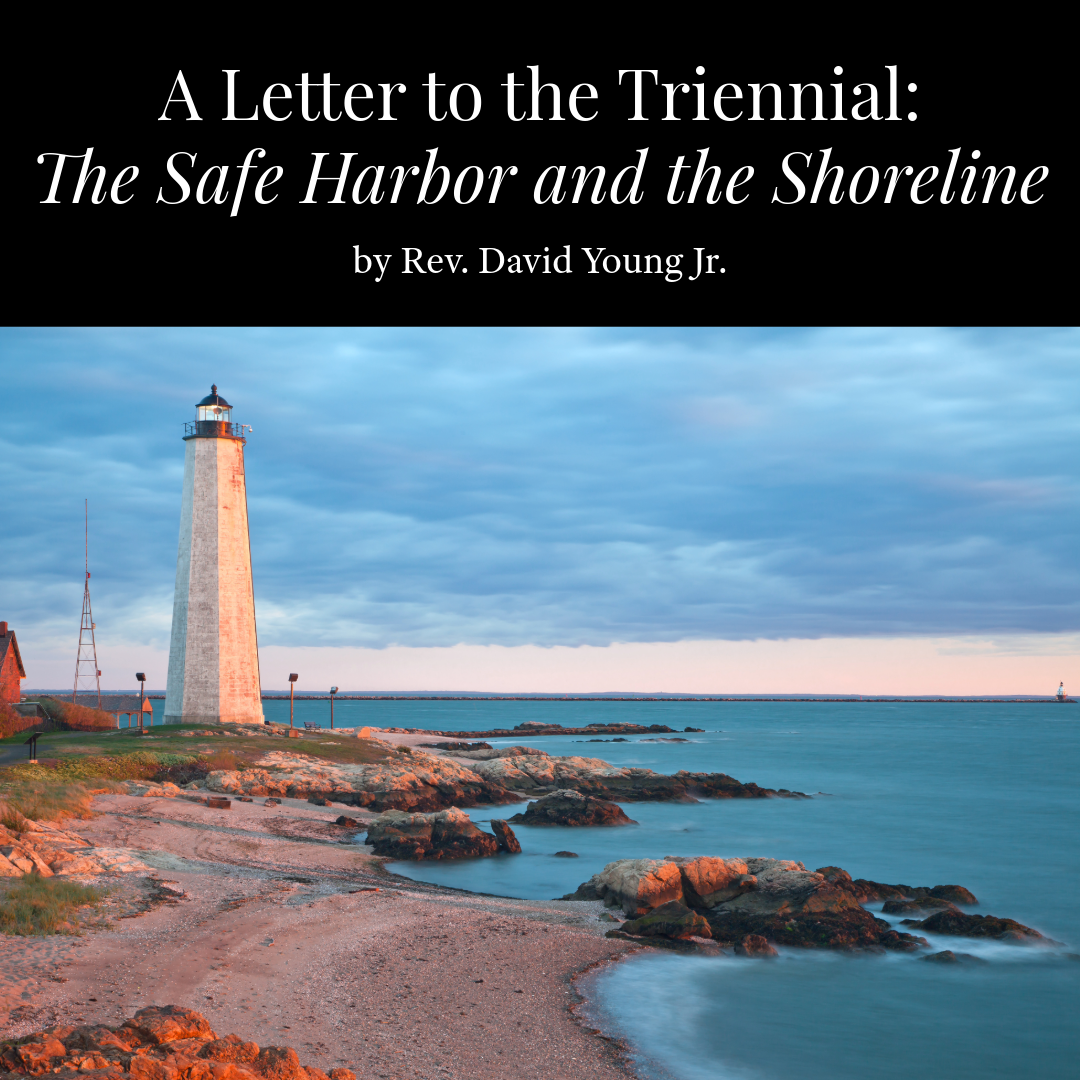
We rightfully boast of our heritage as a "People of the Book," an identity built on an open Bible and relentless scriptural study. Yet we have fallen prey to a dangerous delusion: the idea that openness means a lack of boundaries. For openness to mean anything at all, we must know where the walls are. You cannot have a safe harbor without a shoreline. The sea of theological reflection is vast and beautiful to behold, but the safe harbor of a shared and grounded theological identity is a welcome comfort when blasted by questions, doubts, and insults from a broken world.
I challenge those who are currently attempting to recast this proposal as a top-down bureaucratic takeover. Let it be what it explicitly claims to be: a clear, measurable standard for membership among our regions, conferences, churches, and ministers. This is not an elder board trying to dictate the private thoughts of every believer in the pew. It is the necessary articulation of our corporate identity. If we are incapable of accurately defining our identity, what right do we have to a future?
To the strict congregationalists who bristle at the mention of boundaries, let us speak truth: Individual liberty was never intended to operate in isolation. A total autonomy that refuses covenantal responsibility strips the local church of its connection to the wider body—and that is a freedom the New Testament nowhere envisions (Galatians 5:13-26). When a community insists on a structure where everyone simply does whatever is right in their own eyes, it invites collapse (Judges 21:25). To be a distinct body, we must possess distinctives. Those called to lead must be able to point to a shared framework (Titus 1:9). We must know what binds us together, what shapes our identity, and what prioritizes our mission. We require a standard by which we can evaluate our understanding and hold ourselves mutually accountable.
The Cost of Compromise
Over the last century, the creeping insurgency of religious pluralism and a hollow, brute ecumenism has quietly made itself at home in our midst. We opened our doors with the best of intentions—with open arms for those looking for a family. In many ways, we are a people well-cast as the misfits and outcasts of our generation, much like our Millerite forebears.
But we must not abandon the lessons those forebears bought with tears and disappointment. Theological drift invariably breeds institutional frustration and decline. Short-term numeric "advances" bought at the counter of theological compromise are an illusion. A sober look at the religious movements of the last two centuries proves that the fallout of unchecked theological error is always paid for in the currency of tattered lives, broken churches, and ruined communities.
Theological accountability is not the enemy of spiritual liberty; they are the two lenses through which we view and protect our faith in Christ. When we refuse to submit to mutual accountability, we are not guarding liberty. We are simply plowing ground to make it fertile for twisted teachings to arise from within our own ranks to disrupt the flock (Acts 20:29-30). It establishes ground where the seeds of error, discord, and pastoral abuse flourish unchecked. If a prospective pastor, conference, or local congregation cannot sign onto this DOP—a document already far more generous in scope than almost any other in the Western world—we must ask the hard question: Do they truly wish to be part of a gathered, covenanted body? An unwillingness to be held accountable is a warning sign that no local flock can safely ignore.
The Logic of Identity
I know the fear that a fixed standard will shrink our numbers. If people choose to depart because they no longer align with our shared standard, then yes, we will be smaller numerically. To deny that is to deny basic math. But the objection itself is fundamentally flawed in its premise. If the very definition of an Advent Christian requires some form of adherence to our core principles, and an individual or a congregation no longer agrees with those principles, then by definition, they are not Advent Christian.
An anchor is only an anchor when it is tied to something. The anchor is the Gospel of Jesus Christ, and the line we must affix to it is a solid cord of biblical and theological understanding, clearly defined. Without that cord, the ship will be tossed about in the storms of error, darkness, and doubt that are raging around us.
The purpose of setting standards is not to arbitrarily gatekeep, but to understand our identity. A headcount built on a theological vacuum is an illusion of growth, not a true body. This document merely crystallizes reality on paper. The path of faith in Christ is one of growth and maturity. To reject adopting a framework of shared belief simply because we cannot agree on every detail, or because our history is one of non-conformity, fails to deal with the biblical teaching of maturity as a mark of the Christian life. We are no longer to be children tossed to and fro by every wind of doctrine; we are called to be mature disciples, eager to build on the foundation laid for us by those who came before in Christ (Ephesians 4:11-16).
In our cultural moment, there is a strong temptation to drift toward a generic, consumer-driven "Christianity" that scratches itching ears and worships human feelings over divine truth (2 Timothy 4:3). But we cannot survive on compromise. The Lord has never possessed an appetite for a lukewarm faith that trades its distinct convictions for cultural acceptance (Revelation 3:16). We are, by divine decree, unique individuals called to a highly specific, corporate life in the covenant of the church.
The Gospel must be the center of our unity. Our secondary and tertiary differences must remain opportunities to sit down and reason together under the shadow of the cross (Isaiah 1:18). The 2026 Declaration may not be flawless, but it represents a far more defined, robust call to unity than its predecessor. It is a path forward that honors the Lordship of Christ and grants us a unified voice to face the trials of tomorrow.
Though I will not stand with you on the convention floor this August, I stand unreservedly with this proposal. I see it as an urgent summons to reclaim our identity—a call to embrace once again our heritage of deep study, theological integrity, open dialogue, and fierce mutual accountability.
I pray that God grants you unwavering wisdom as you consider, and abundant grace as you dialogue.
Humbly your brother in Christ,
Rev. David Young Jr.
David Young Jr. is an ordained minister with over 20 years of experience pastoring Advent Christian congregations in Maine, Ohio, and Vermont. A native Mainer, he began his theological education at New England Bible College, pursuing a BA in Bible and Pastoral Ministry, and later transferred to Luther Rice University, where he earned a BA in Religion/Apologetics and began graduate work in Christian Studies. He is currently pursuing a Master of Divinity at Liberty University. His ministry is deeply intertwined with a distinguished career in public safety; a state-certified Emergency Management Director and Civil Air Patrol Wing Chaplain (Captain), he is a recipient of lifesaving awards from both the Vermont Department of Corrections and the Civil Air Patrol for his role in preserving life. Having served in numerous local and regional denominational leadership positions over the years, David writes with a deep passion for practical theology, practical ecclesiology, Christ-focused leadership resiliency, and mentorship. He resides in Springfield, Vermont, with his wife, Ann, and their two sons, Caleb and Connor.