
It's All About Our Union with Christ - Justin Nash, ACGC Executive Director
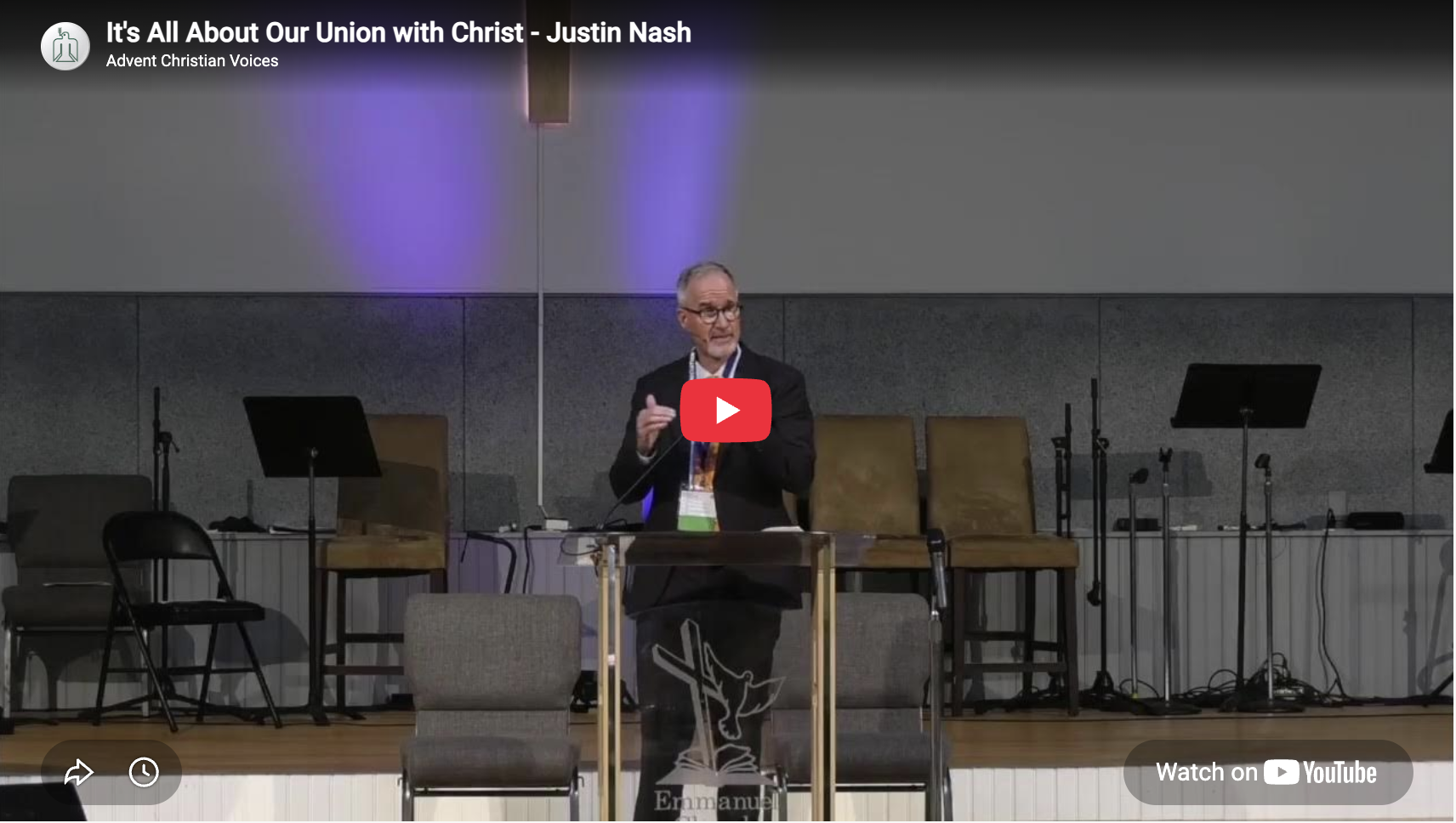
This message was given at the 2026 Annual Convention of the Advent Christian Eastern Regional Association. Rev. Justin Nash exegetes Ephesians 2, meditating on the Church’s union with Christ. The following transcription was generated by AI — any question of accuracy should be checked against the video.
Well, good afternoon. Let me just begin by saying I will not take it personally if you fall asleep. So, no, I know we are right after lunch and so I'm just happy to be here. I do feel a little bit like a Single-A player that's been called up to the majors. So, in all seriousness, it is a great honor and it is a great privilege to be here and share with you today and I'm very thankful for the opportunity. If you have your Bibles, I invite you to turn with me back to the book of Ephesians, but this time to Ephesians chapter 2.
And we're going to look at the entire chapter just like Doug did. Let us read from the living Word of the living God.
And you were dead in the trespasses and sins in which you once walked, following the course of this world, following the prince of the power of the air, the spirit that is now at work in the sons of disobedience, among whom we all once lived in the passions of our flesh, carrying out the desires of the body and the mind, and were by nature children of wrath like the rest of mankind.
But God, being rich in mercy, because of the great love with which he loved us, even when we were dead in our trespasses, made us alive together with Christ—by grace you have been saved—and raised us up with him and seated us with him in the heavenly places in Christ Jesus, so that in the coming ages he might show the immeasurable riches of his grace in kindness toward us in Christ Jesus.
For by grace you have been saved through faith, and this is not your own doing. It is the gift of God, not a result of works, so that no one may boast. For we are his workmanship, created in Christ Jesus for good works, which God prepared beforehand, that we should walk in them.
Therefore remember that at one time you Gentiles in the flesh, called the uncircumcision by what is called the circumcision, which is made in the flesh by hands—remember that you were at that time separated from Christ, alienated from the commonwealth of Israel and strangers to the covenants of promise, having no hope and without God in the world. But now in Christ Jesus, you who once were far off have been brought near by the blood of Christ.
For he himself is our peace, who has made us both one, and has broken down in his flesh the dividing wall of hostility by abolishing the law of commandments expressed in ordinances, that he might create in himself one new man in place of the two, so making peace, and might reconcile us both to God in one body through the cross, thereby killing the hostility.
And he came and preached peace to you who were far off and peace to those who were near. For through him we both have access in one Spirit to the Father. So then you are no longer strangers and aliens, but you are fellow citizens with the saints and members of the household of God, built on the foundation of the apostles and prophets, Christ Jesus himself being the cornerstone, in whom the whole structure, being joined together, grows into a holy temple in the Lord. In him, you also are being built together into a dwelling place for God by the Spirit.
Let’s pray. Father, we thank you for your word. It is a gift that you have chosen to preserve it for us. That you've chosen to give it to us in a form we can read and understand. And so Lord, now I just pray that as you speak through your word that you would be heard clearly. Pray that I would not be heard, but that you would by your spirit give us all ears to hear you, eyes to see you, minds to understand, and hearts to believe. That you would work through your word to teach us that which we do not know.
To enlighten our eyes to the great and glorious truths that are in Christ. Lord, make us that which we are not. Teach us that which we do not know. And do it all, Lord, for your glory and for the building up of your church. And all these things I ask and pray in the name of Jesus. Amen.
So, I appreciated Doug earlier today and I told him I'm so glad I didn't have that passage. Because it is a it is dense and it is difficult. And so I appreciate what Doug did for us today. And my assignment is maybe slightly less daunting but still pretty daunting. And so I wanted to think about how to approach this passage. And one of the glorious truths of the gospel that I'm so thankful for is that as each of us has received God's grace in Jesus Christ, he has saved us. He has not saved us to be alone but he has saved us to be with other Christians.
He has saved us into his church. And so I want us to think about how this passage helps us to see our salvation not just personally and individually but corporately as the church of Jesus Christ. And how it shapes and forms what a church is and what a church does because a lot of churches begin by defining a church by what it does. You know, churches, they worship, they preach, they do evangelism, they serve, all these different things and those are good things. But I think we can get ourselves into trouble when we approach it that way.
Pragmatism can easily become our master. We can do what works rather than what is true and what is pleasing to Christ. And I think that's where many churches find themselves today. They're trying to figure out, well, what can we do differently? And they're doing that without first considering, well, who are we? What is true of us? The late Howard Hendricks offered this word of advice. “My great concern for you in life is not that you will fail, but that you will succeed in doing the wrong things.” And so I think this is where many churches maybe find themselves today and they are succeeding in the wrong things because they've begun at the wrong place.
See, I believe doing proceeds from being. Teleology flows from ontology or theology precedes practice. However you want to think about it. But who we are shapes what we do. And this is actually how the book of Ephesians is set up. The first three chapters are indicatives. They're this is what is true of you in Jesus Christ and then the next three are the imperatives and this is how you live out of that truth. And so have the privilege of sort of expanding on what Doug talked about. But Martyn Lloyd-Jones speaking of Ephesians 2, he said Ephesians 2 and 3 was actually an expansion of Ephesians 1:18–19.
That this was Paul actually expanding and enlightening. He was showing the church what is true. He was mining the depths of those glorious riches in Christ. And so that's what I want us to try to understand today. What is a church? What is true of a church in Jesus Christ? And here's the big idea. The big idea is this. That our union with Christ is the foundation and power upon which a local church is established, is held together, and grows. A local church is a community that is founded by Christ, endures through Christ, and exists for Christ.
So again, our union with Christ is the foundation and power upon which a local church is established, is held together, and grows. A church is a community that's founded by Christ, endures through Christ, and exists for Christ. Now, one of the rich themes in this book and in frankly in all of Paul's writings is this idea of union with Christ. And I want you to just later, just go through Ephesians. Go through the first three chapters of Ephesians and underline every time you see the phrase in him or in Christ or some derivative of that and you will be amazed.
It's it's this constant theme in Paul's writings, our union with Christ, how we're united to him in faith. And so this is what I want to talk about and how our union with Christ shapes who we are as the church and how it should shape what we are in our local churches. So I've divided this up into kind of three main sections here for us this afternoon. And each section I think follows a similar pattern. And the pattern is this that Paul is going to tell us tell us about our old identity, who we were.
Then he's going to tell us about the work of Christ and how that work made us someone new. He's going to tell us our new identity, who we are now in Christ. And so Jesus is the pivot point. Jesus is the pivot that makes us no longer who we were, but who we are now because of his work on our behalf. So I want us to see three things this afternoon as we consider what a church is. That a church is a community that is resurrected with Christ. It is a community that is reconciled through Christ.
And it is a community that is reforming by Christ. So we'll go through each one of those.
So, first, a church is a is a community that is resurrected with Christ. And so, here's kind of the main idea here is that a church is a community that has been resurrected from spiritual death to spiritual life solely by God's grace in Christ. That's the idea that a church has been resurrected, and I think that's the right word, and we'll see why in a minute. Resurrected from spiritual death to a spiritual life solely by God's grace in Christ. And Paul begins there and Doug alluded to this earlier, but our old identity.
Paul doubles down. He digs down deeper to help us understand who we are in verses 1 through 3. And he tells us, you know, there is nothing if we are honest with the gospel, there is nothing like the gospel that is as offensive and demeaning to natural people, to unsaved people. It is true because it goes to our very core and it says, you know, it shines this bright light on who we who we really truly are. As Tim Keller said, the gospel shows us that we are more sinful and flawed in ourselves than we ever dared believe.
However bad I think myself to be, Paul says I'm worse. And believe me, that’s saying a lot. But I want to be clear: this is in the past tense. At the very beginning, I want to be clear. You were dead. You're not dead anymore. You were dead. He's talking to these people. But again he tells us some important things. First he says that we were dead in our sins and trespasses. We are not damaged. We are not sick. We are not struggling. We were dead. And we were not “Princess Bride” mostly dead, okay?
We were completely totally dead. And as Advent Christians, we should understand what it means to be dead, right? That’s part of what we believe. But of course, we weren't dead physically. We were spiritually dead. That's his point. Because why? Because sin was our identity. He says we were dead in the trespasses and sins—in our trespasses and sins. It was our identity. We didn't do sin. We were in sin. We breathed it. We consumed it. It consumed us. As saying goes, we were not sinners because we sinned. We sinned because we were sinners.
It's what shaped us and molded us. We were united to sin in our inmost being, Paul says. But he goes on, he gives us more. He says in all that we were following the course of this world. We were following the prince of the power of the air and the spirit that is at work in the sons of disobedience. We were slaves. We were servants. I think as Bob Dylan said, everybody's going to serve somebody. And that's true. We're going to serve. And Paul says who we were serving was this world and its ways.
And it was Satan. And it was that spirit that pervades all that. And yet the great irony, of course, is that we had convinced ourselves that we were free, that we were not shackled by morality and this terrible biblical ethic and this God of the Bible. No, we thought we were free, but Paul says, “No, we were slaves.” And he goes on, "We were living in the passions of our flesh, carrying out the desires of the body and the mind." Paul says, "You weren't living like people. You weren't living like people made in the image of God.
You weren't living rationally. No, you were more like animals, driven by instincts, driven by passions, driven by emotions. We were in the end by our natural selves." He says, "We were children of wrath." Now, more than hundred years ago, there was a liberal Protestant theologian named Adolf von Harnack and he coined a phrase that's still I think pretty popular today. The universal fatherhood of God and the universal brotherhood of man. And perhaps you've heard that before. Well, the Apostle Paul says that's not true at all. We’re not children of God.
What are we? We’re children of wrath. Wrath that is deserved. That's who we were. And this is true. Like I know some of you, I know some of you well, some of you not at all. But here's what I can tell you is that this is true of all of us. This is true of me. It was true of all of you. And that's what Paul says. Like the rest of mankind. Now, it may have looked different. You know, our sins may have manifested themselves differently, but in the end, this is who we were naturally in ourselves before Christ.
And one of the real practical implications of this, I think, is when we as Christians, when we as the church, when we're sharing the gospel, we have to include this because the good news of the gospel makes no sense at all without this bad news. Until we know we need to be saved, we're not going to want to be saved. And so, this is where Paul puts us. He puts us in this helpless and hopeless situation. But then verses 4-9, Jesus shows up and he changes it. And Paul takes us from this point of utter despair to grand and glorious hope with two words.
But God, right? You were children of wrath. That's who I was. I was a child of wrath. But God, I think if you sum the gospel up in two words, that might be a pretty good two-word summation of the gospel. But God, this God who he says is rich in mercy. This God who loved us. He loved us so much. He did not give us the wrath we deserved. Instead, he showed us mercy. This God who loved us with this great love. Not while we were friends, but while we were rebels, we were traitors.
Paul later says we were alienated and strangers. And yet he saved us because of his great love, because of his great mercy. And so what did Jesus do? How did he act upon us? How did Jesus act in us? Well, Paul says it. He says the very first thing he did was the first thing that had to be done. He made us alive. He made us alive together with Christ. He did the only thing that could be done to improve a dead man's situation. He didn't prop us up. He didn't dress us up.
He didn't put us in nice clothes. No, he breathed life into us. We were dead. Now we're alive. And that is in Christ, because of what Jesus has done for us. And this is where I believe our union with Christ begins to come into focus. The same resurrection power that raised Jesus from the dead raised us from spiritual death. And one day he will raise us from the dead—from physical death. But even now he raises us. He raised us. It's past tense. He raised us. And now some of you may disagree with this and it's fine and you can correct me later.
But I really believe that when someone is saved, when someone comes to faith in Jesus Christ, I believe that is no less a miracle than Jesus raising Lazarus from the dead. He does this miraculous thing. I was dead, and he made me alive. How much greater can it be than that? In the very beginning, this is what Jesus does for us. But that is not all he does for us. Paul says that he raised us up and seated us with him in the heavenly places. Yeah, Jesus gave us life, but he gave us a different kind of life than what we had before.
It wasn't our old life. It wasn't our mundane life. It wasn't our humdrum life. No. What did he do? We were paupers. We were slaves. He raised us where? To royalty. To be seated with God in Christ in the heavenly places. This is what God has done for us in Jesus Christ. He raises us to glorious abundant life. This resurrection power is now ours. These glorious riches, every spiritual blessing in the heavenly places are now ours in Christ Jesus. This is the life we've been raised to. And Paul goes on to explain why God did this in verse seven.
This may be the most controversial thing I say today, hopefully. In verse seven he says so that in the coming ages he might show the immeasurable riches of his grace in kindness toward us in Christ Jesus. So why did God save us? So that he might show the immeasurable riches of his grace in kindness toward us in Christ Jesus. And I would contend that what that is saying is the primary reason God saved us was for his own glory. That the gospel is first and foremost about the triune God of the universe.
Now, we are wonderful beneficiaries of that. We are wonderfully blessed through that and certainly God loved us greatly to do that for us. But in the end, I think this is what Paul’s saying here. He did it so that everybody might see the immeasurable riches of his grace and kindness in Christ Jesus. So the world might see that. Derek's going to talk about how it was the church’s job to show the manifold wisdom of God, right? And this is what it is. He's showing his greatness and his manifold love and mercy and grace and glory.
And so this is the gift that is given. And what do we do to gain it? How are we brought from death to life? How are we saved? Well, Paul says it very clearly in probably what is the two best known verses in this book, verses 8 and 9. How are we saved? We are saved by grace alone, through faith alone, in Christ alone. There's a big thing in 1517 called the Protestant Reformation that mined from that quite a bit. Saved by grace alone, through faith alone, in Christ alone. And in part, I think this is Paul doubling down on the idea that God saved us for his glory.
By making it clear that we do not in fact we cannot save ourselves. Salvation is a gift. We cannot work for it. We cannot merit it. We don't earn it in any way. It is grace. It is pure grace. We do nothing, no works at all to be saved. Even the faith we exercise, Paul says here is a gift. Jonathan Edwards one of my favorite Jonathan Edwards quotes. He said, "The only thing we contribute to our salvation is the sin that made it necessary." And I think there's just a ton of truth in that.
And this is glorious. This is a glorious thing that we are not saved by works, but we are saved by a gift, by God's gracious grace and mercy and kindness to us in Jesus Christ. So we are saved by grace alone through faith alone in Christ alone. So that all the glory goes to God alone. And so what does this make us? What is our new identity? Who are we now in verse 10? Well, who we are now is we are his workmanship created in Christ Jesus for good works which God prepared beforehand that we should walk in them.
The result is we are raised to this new life of walking in good works according to God's sovereign plan. Notice the juxtaposition with who we were earlier. What were we walking in before? We were walking in our sins and our trespasses. We were dead; we’re now alive. We were following the world. We were following Satan. We were following our own passions and desires. Now we are raised to a new life in Jesus Christ, walking as his children with him in good works. This is who we are now. This is what God has done for us in the Lord Jesus Christ.
We were dead. Again, I can't say it enough and I hope you get it. If you don't get anything else, we were dead and now we're alive. What an amazing thing. How many How many of you have known dead people who were dead and then came back alive? Not many, right? I’m guessing. This is because it's such a miraculous thing that he does for us in Christ. And so this is who we are in our union with Jesus. And I think this means a great deal to local church and how local church thinks about functioning and how we do things and who we are.
First, this has to be the foundation of every church. The life, death, and resurrection of Jesus for the forgiveness of our sins has to be the foundation of every church. If we get on anything else, we're not going to make it. Remembering who we were and what Jesus did for us. That is the basis of our love and our gratitude and our worship for him. Remembering that we were dead and that God resurrected us—again, this is where the gospel is so offensive, I think, to our natural selves. The gospel, if rightly understood—if we get it, if the eyes of our heart are enlightened— the one thing it will surely do in us is it will absolutely crush any vestige of pride or self-righteousness.
It will destroy it because we couldn’t help ourselves and God saved us. We were dead and he made us alive. And so I think what in part what that means is this room and our churches should be places full of humble, loving and thankful people because we are resurrected people.
But because of our union with Christ, we are also a reconciled community of people. This is verses 11 through 18. Paul here points to another problem we had in our natural state. Yes, we were alienated from God, but we're also alienated from other people. And so, here's the point here is a church is a community that has been reconciled to God and one another through the sacrificial death of Jesus. We've been reconciled to God and to one another through the sacrificial death of Jesus. Again, what's our old identity? Again, it's it's pretty dire.
Verses 11 and 12, Paul says that we were uncircumcised. We were separated from Christ. We were alienated from the commonwealth of Israel. We were strangers to the covenants of promise. Now, to be called uncircumcised was a Jewish term of derision. It signaled that one was a gentile and outside the covenant community of the people of God. That so there was two classes of people as far as Jews were concerned. You were Jews or Gentiles and they hated one another. It was a centuries-long enmity between them and it was a significant hatred that they had.
They were separated from Old Testament Israel And salvation, John 4:22 says, is from the Jews. So they were cut off from Christ. He uses this phrase strangers and aliens. And this was a sort of a political term. It spoke to foreigners with no rights or privileges in a city. And so he says, you're you're separated from all that and the covenants. You're you're separated from the covenants, the Old Testament covenants. The covenant he made with Abraham, the covenant he made with Moses, the covenant he made with David. He says, "You're separated from all that."
Now, to be clear, I this would have been all of us. This church in Ephesus, this would have been full of Gentiles. And this is as best I understand it and there are people who know more here about this than me, but that this was actually one of the biggest problems in the early church is when Gentiles began to be saved, they really struggled with how do we incorporate Gentiles into the church and what does it mean? And you get into questions, well, do they need to be circumcised and keep the ceremonial laws and all these different things.
And so, this was a really big challenge to the early church that Paul is addressing here. Now, he's speaking to the Ephesians from the Gentile side of things. In other places, he speaks from the from the Jewish side of things, but he tells us here, but he sums it up. If you want to know our predicament, if you want to know where we are, he sums it up very clearly here. Having no hope and without God in the world. This is who we were. No hope without God in the world.
This is where we found ourselves. And so then he introduces again the work of Jesus. Now earlier in Ephesians and I think Doug covered this well today. We see God the Father was in some ways the center of the action. A lot of what was happening was attributed to his work. But now the focus begins to fall on Jesus and his redemptive work and his unifying work. And Paul says that his work to reconcile was both vertical and horizontal. That is he reconciled us to God and he reconciled us to one another.
He says that we have been brought near by the blood of Christ. Very simply, it is the sacrificial death of Jesus on the cross that is the means of our reconciliation. That is how we are made right. That is how we are reconciled to God and to one another. His death in our place satisfied our sin debt before God. His death in our place expiated it removed our sin and our sin debt and he clothed us with his righteousness. And Paul says he did it by abolishing the law of the commandments.
He broke down the dividing wall of hostility and he himself was our peace. He abolished the laws. He abolished the laws not by saying they don't matter. He abolished the laws by completing them by perfectly keeping them. That's what he did. And so he kept it. He kept the law and in that sense they were finished and they were complete and that is credited to us. But this is an interesting phrase he has here. But he broke down the dividing wall of hostility. Now what Paul is likely alluding to here was a feature in the temple at Jerusalem.
And I bet Mike probably knows all about this again a lot more than I do, but apparently there was a wall but separating the what was called the court of the Gentiles and the inner court. And the Gentiles could stay outside of that. But there was a sign on that wall that said Gentiles if you go any further you do so under the penalty of death. You are not allowed to move past this point. So they were forbidden from physically from getting close to the temple in Jerusalem. But this was a hostility and an enmity that wasn't merely physical.
Again, it was spiritual. It was relational. But I think one of the things Paul's getting at here is the primary the primary cause of their separation, the Gentile and Jew separation was not horizontal, but it was vertical. It was because the Gentiles were separated from God because they were apart from God. They were apart from God's covenant people is sort of the idea. And so the division between people was simply an effect. It was it was a symptom of a division between God and man. So the first step to reconcile Jew and Gentile was to reconcile Gentile and God.
And it's in Jesus this vertical reconciliation is found. Paul's phrase here is interesting. We don't completely fully understand what he means. Some of the mystery that Jesus, he himself is our peace. It's Jesus who first brought us near to God. He brought peace between us and God. But he didn't just merely bring peace. He is peace. His death, his person is reconciliation. He is our peace. And in some way, whatever that means, he is the glue that reconciles. He is the bridge that bridges the chasm. Between God and people. And so this is what Jesus did for us.
He reconciles us to God. But Paul says something else really wonderful happened when that happened. Not only were we reconciled to God, but we became reconciled to everyone else who was reconciled to God in Christ. Right? Just to get that again. When we were reconciled to God in Christ, we were reconciled to everyone else who was in Christ, right? And so this is who we are. And he says here that he broke down the dividing wall of hostility. The dividing wall of hostility—he killed it. He reconciled us both to God in one body.
Again, I you know, Doug covered this very well earlier, but again, the this thing just the Trinity just drips all through this thing. I mean, you just see it. You see it here. Believers, we have access to God through the Holy Spirit because of Christ’s death on the cross right here. We see this work. Christ destroyed this enmity. Paul says, "Therefore, Jew and Gentiles should no longer be hostile towards one another. There's no reason for it because we have been reconciled in Christ.” And he says that he made one new man out of the two.
The result was not two kind of separate identities. But no, Christ made something new. He made a new man. This new class of people, those who were in Christ. I actually don’t think Paul would have ever called anyone a Christian or he would have asked you if you're a Christian. I actually think he would have said are you in Christ? I think that's what Paul probably would have said. And so that's what he's saying. He's saying Jesus in his death in his and particularly here in his death, his sacrificial death, in that reconciling act, he reconciled us together to such a degree that we are now something new.
We're no longer Jew. We're no longer Gentiles. We are now in Christ together and this is who we are and this is our new identity. Verses 15- 18 again that we see the work of the triune God here. He says we both have access in one spirit to the Father. Again notice what he said before. Who did we follow before? We were following the spirit of this world. The spirit that was at work in the sons of disobedience. But now what are we following? We are following the indwelling Holy Spirit of God.
He says we share in one Holy Spirit who gives us free and open access to the Father and we call him father. We are adopted. Doug talked about that earlier. We have been adopted into the family again. What were we previously? We were dead. We were alienated. We are separated. Now we have been brought near fully and eternally reconciled to God in Christ. And we are united again to one another. It was interesting Jamie Dunlop makes this observation about the gospel. He says “It doesn’t merely bring people together to tolerate each other but to be so tightly committed that Paul can call them a new humanity and a new household.
Paul reaches for the natural world’s deepest bonds—the bonds of ethnicity and family—to describe this new community in the local church.” Jesus didn't reconcile us to God and to one another so we could tolerate each other. And I'm thankful for that because I'm hard to tolerate. But no, so we could love one another. So we could we could be a family. We could be this new thing united in Christ. And so what I think this means for a local church at least to some degree is this. That is a church ought to be a place where those who were once at war with one another are now fellow saints and citizens where they can be families of the household of God where former enemies can love one another rather than hate one another.
D. A. Carson puts it this way. He says, “The church is not made up of natural friends. It is made up of natural enemies. What binds us together is not common education, common race, common income levels, common politics, common ancestries, common accents, clearly common jobs or anything else of that sort. In this light, they are a band of natural enemies who love one another for Jesus’ sake.” That is a church. We are a band of natural enemies who love one another for Jesus' sake. Think about how compelling that is to the world if we're living that way.
And this is true of us, right? So if we're living out of that truth, because really there's no problem for people who are like and who like one another. It is no problem to get along with people who are like you. But no, the church is something quite different. It's it's quite miraculous. People can build communities around all sorts of stuff, good things, similar life experiences, similar identities, similar causes, similar needs, similar social position, but that is easy and it requires nothing supernatural. But the church is different. Let me just ask you this question.
Just something for you to take and think about. Would your church look the way it does even if Jesus had not died and reconciled us to himself? In other words, is there anything at all supernatural about your community? If an outsider walked in, would she see a church community that defies natural explanation on some level, or would she just see another club of like and like-minded people? We are called to be different. We are called to be a place where natural enemies suddenly become friends. In our world, our nation, our communities are more divided maybe than ever.
And people are looking for all kinds of solutions to this division, to this hostility. But I'm going to tell you, none of them are going to work because they're all worldly. They're born of a human wisdom and sinful human hearts. The only real true lasting answer to division and hostility is the gospel. Because it is only the gospel that corrects the root problem. Only the gospel reconciles us to God and fixes that alienation, not just the symptoms. Only the gospel provides a sufficient and unifying mortar to bind everyone together in Jesus, his life, his death, his resurrection.
And so a local church should be a model of that kind of reconciliation of kind of that model of unity and diversity. You know, a church should look like a family. It should be grandparents with gray hair all the way to babies, school children, newlyweds, empty nesters, and maybe even a crazy cousin or uncle none of us want to talk about. Blue-collar, white-collar, artists, engineers, Fox, NBC, and yes, the gospel is even so powerful that Red Sox and Yankees fans could be in the same church and still love one another.
It's how powerful the gospel is. Not to make light, but there's a couple Red Sox fans, at least two Yankees fans in here. A church ought to be a group of people who naturally wouldn't hang out, don't get along, and perhaps would even be hostile towards one another. Yet, they all get along and serve one another and love one another because they are all redeemed and reconciled by the blood of Christ. That is what a church is supposed to be. It's who we should be. It means that when we have fights and we're going to have conflict in our church, but we should always be the quickest to reconcile.
We should always be the quickest to forgive. We should always be the quickest to show grace and mercy because of the grace and mercy we've been shown. The reconciliation that we know through Christ.
So church is a community reconciled through Christ. Verses 19- 22, a church is reforming by Christ. Again, Paul turns here to a different metaphor. The point here in this idea is that a church is a community that is constantly being built up and reformed by the power of the Holy Spirit. So, verses 19- 22. In verse 19, he returns to this idea of our old identity. He just very quickly kind of returns to it briefly. He says, "We were strangers and aliens." Again, he goes back to the language he used in verse 12 to remind us who we were.
We were strangers. We were aliens. We were separated from God, separated from man. But then in verse 20 and 22, he begins to talk about the work of Christ. And again, he uses this image of a of a of a building. He says Christ is the cornerstone. This idea that Christ Jesus is not only the cornerstone, but he is the builder of the church and he is the mortar that holds the church together. And so he says here that the foundation of the church is the apostles and the prophets. Now again, I'd be curious what people think about this later.
I'm not sure it's the apostles and prophets themselves so much he's talking about here as the words that they spoke that it was the divine inspiration of their words that is the foundation for the church that the church is to be built on. The foundation of the church is the Word of God spoken through God's prophets and apostles I think that's what he means now you can again correct me later if you think I'm wrong. But the apostles and their words were penultimate. They weren't ultimate. No, Jesus is ultimate is what Paul says because they're the foundation.
But what is Jesus? He's the cornerstone. He's the first stone. He's the stone that's laid down that gives shape to the building. Everything else, the foundation and everything is oriented to that cornerstone. It is it is the central piece the primary piece of that structure. Everything else was fixed to it. This reminds us that what Jesus is and what he has done is the non-negotiable starting point for every church. Again, as the cornerstone, Christ gives a church its shape, its size, its orientation. Everything a church is and does begins in the person and work of Jesus Christ.
This is what Paul is getting at here. And a church built on anything else other than the person and work of Christ, the eternal son of God, even if it somehow tries to be built on the Word of God more generally, it's going to ultimately be misshapen and unstable and collapse if it is not built on the person and work of Christ. And so this is what Jesus has done. He is the cornerstone. He is the builder. He is the one that brings it all together. And who are we? What is our new identity?
We were strangers and aliens. Well, verse 19. We’re no longer aliens and strangers. What are we? We are fellow citizens with the saints and members of the household of God. This is who we are now. We are fellow citizens with the saints. We serve the same king. We serve the same kingdom. We're members of the same family, the same household. We all now have the same father. This is our gift. This is what we are given in Jesus Christ. And then he goes on to say this, and this was a helpful insight for me recently.
He says, "We are being built into a dwelling place for God by the Holy Spirit." We are being built. We are being built together by God the Spirit.
So, first, this reminds us that in the church we have a unique power source and that's the Holy Spirit. So if everything that happens in this church any church can be explained by human wisdom, human hard work, human intelligence, then I think something is wrong. There should be something in a church that we don’t know how this works. We don't know why this is true because there should be something supernatural about church because it is the Holy Spirit who gives life. It is the Holy Spirit who brings comfort and correction and who teaches.
And so we must rely on the spirit to do this transformative reforming work in us. It is the spirit who is continually growing Jesus’ church into a temple of God. Now again, think of this for a second. Who were we before? Who were the Gentiles before? Where were we? We were outside the temple. We couldn't go past the wall. We had no access. But who are we now? We are the temple. God dwells in us in the person of the Holy Spirit. This is what Jesus does for us in his redeeming, reforming, reconciling work.
But this is a current and ongoing work. The church is not finished. She is not complete. There’s still more to be added to her family. She is under construction. She's not fully glorified, not fully sanctified. This means she will not be perfect and she shouldn't be expected to be. This is important. I think a lot of people have a lot of they have unreasonable expectations about what a church is and what a church is supposed to be. Church is never supposed to be perfect. Not in this world. Not until Jesus returns.
Why? It is being built together by the spirit right now. It is being built. The Lord is working. You wouldn't go to a construction site and criticize a half built building. You said, "That's a terrible house." Well, of course it is. It's not finished. A lot of you may know that the Billy Graham Evangelistic Association is based in Charlotte and Ruth and Billy Graham are both buried there. Have you ever been there? So, you can go visit their graves. Ruth and Billy are both there. Ruth's gravestone tombstone is actually the more interesting of the two to me and because she has this phrase on there and if you've been there, you're going to know what this is.
But engraved on her tombstone, it says “End of construction. Thank you for your patience.” Well, that's the church. The church is under construction until Jesus returns. So we need to understand that this idea of we're always supposed to be reforming as the church. This was a Reformation cry: semper reformanda. Always reforming by the Word of God. And this is because we are we're always reforming. The Lord is continuing to sanctify not just us as individuals but us as his church. And so what does all this mean for a church? So it means again that Christ is the cornerstone.
And so he has to be preeminent in everything a church is and does has to be the central identity and practice of a church because the church is the only institution authorized by Jesus to proclaim the message of life. It is the only institute that God has said this is your job to proclaim life from death to proclaim the gospel of salvation in Jesus Christ. Now churches can do all sorts of good things for our neighbors and still miss this most important thing. We must never forget that the mission of the church is not to redeem the culture.
The mission of the church is to proclaim the gospel and make disciples. The church can feed the hungry, clothe the naked, heal the sick, care for the poor, educate the less fortunate, and any number of other good, godly, loving acts for our neighbors. And the presence of a church should make any community demonstrably better. But none of these things is the mission that Christ gave to his church. Matthew 28 was go and make disciples. He didn't give that message to anyone else but his church. The church is the only institution in the history of the world that has been commissioned by the son and empowered by the Holy Spirit to proclaim the forgiveness of sins in the name of Jesus as the only basis of life, death, and resurrection.
Only the church has been given the keys to the kingdom of God. Only the church has been authorized to pronounce the terms of eternal life. And it does so with the full authority and authentication of Jesus. And when local churches lose sight of this, I believe we have lost and failed the primary task we've been given. Again, you may disagree, but I don't believe our pulpit should be filled with words of political commentary and analysis on current events or therapeutic self-help strategies. The world provides plenty of that. But the pulpit of the local churches should be substantively different.
The announcement of Christ crucified, risen, and coming again should be an ever-flowing river from our pastors and preachers. Because if the good news of the gospel of Jesus Christ is not preached, if it is not proclaimed and pronounced in the local church, where else will people hear it? Every aspect of a church ought to be grounded on, shaped by and driven by Jesus and his gospel. And to lose this is to lose the cornerstone and thereby risk losing the church. Secondly, don't expect your church to be perfect. If you find a perfect church, don't join it because you will ruin it.
And I would too. The church is still under construction. The master builder and architect is refining his masterpiece. The bride is still being prepared for the wedding feast. And so rather than criticize this unfinished state, we should recognize that the work is ongoing. And what this means sometimes is yes, hard hats and steel-toed boots will be necessary, but he is building it for sure. He has promised, I will build my church. He is building his church. And the Holy Spirit is the power source for this. And I know a lot of you pastors probably have been to a lot of conferences where they teach you a lot of things about how you can make your church and be all the great things their church was.
But I think we think far too highly of ourselves and our own methods, our own abilities, our own strategies rather than understanding that the work of building the church, the work of reforming the church, the work of sanctifying the church is the work of the Holy Spirit. And so we can rest assured that Jesus will do that. But we have to trust the spirit to do that work. We have to be sensitive to the spirit. We have to be seeking the spirit. We need to try to be living in that power.
And I think the most practical implication of that is it should drive us to our knees constantly to ask God to do what only he can do and only he can build his church. Only he has the power, wisdom and authority to do that. A church should be ever reforming by the power of the Holy Spirit.
So what is a church? A church is a community that has been resurrected from spiritual death to spiritual life solely by God's grace in Christ. A church is a community that has been reconciled to God and one another through the sacrificial death of Jesus. A church is a community that is constantly being built up and reformed by the power of the Holy Spirit. Our union with Christ is the foundation and power upon which a local church is established, held together, and grows. A local church is a community that is founded by Jesus, endures through Jesus, and exists for Jesus.
And this is true. It's not going to be true. It’s not that it might be true if we can work to get there. No, it is true. It's true right now. That's what Paul's saying. We don't have to earn it. We don't have to make it happen. We have been blessed in Christ with every spiritual blessing in the heavenly places. And this is why what Doug talked about earlier is so important. When we understand that this is true, the more we learn about it, the more we understand it, the deeper we go, the more this truth becomes true in our life and practice.
As we as we understand these things are all at our disposal right now because of our union with Jesus. And as we grow in understanding, in our depth of knowledge, as the eyes of our heart are enlightened and he gives us wisdom and revelation and we understand what is true, then it changes us and it helps us to understand that we are resurrected, that we are reconciled and that the that the spirit is reforming us and changing us. Actually, I have the only imperative in the first three chapters in verse 11, right?
And Doug mentioned that. I have it right here in verse 11. He actually says it twice in 11 and 12. The only imperative is what? Remember. Remember. This is what we are called to do. We are called to remember. Remember who we were. Remember what Christ has done for us. And remember who we are now because of what Christ has done for us. This is what Paul is getting at. This is why we need the eyes of our heart enlightened. This is why we need the spirit of wisdom and revelation.
And so my prayer for all of us, especially for me, is that God would give us the grace each day to comprehend the infinite depths of Christ's glorious riches for us and that we might live more fully in the immeasurable greatness of our union with the Lord Jesus Christ.
Let's pray.
Father, I stand in awe of your greatness. Lord, I was dead and you made me alive. I was dead. You made me alive by your grace according to your mercy. Not because I was good, but because you love me. And this is true for everyone who is in Christ. We are all united to Christ in faith. You reconcile us to yourself which is a grand and glorious mystery that we will mine for all of eternity but you also reconcile us to one another in your church and so Lord we thank you that even today our churches are a foretaste of your coming kingdom when people from every tribe and tongue and nation will gather together we are all very different.
But the one thing that holds us all together is Jesus. And so, Lord, if I have stammered, if I have confused, I pray you would bring clarity. But most of all, Lord, I just pray you'd help us to understand the depths and the richness of what you've done for us in Jesus. And that it might shape us and mold us into what is already true about us in Christ. And Lord, we look forward to that day when you finish your work. When the Holy Spirit is no longer building, but we will be built.
And we praise you and we thank you for that day. Now, to you that's able to do exceedingly more than we can ask or imagine according to the power that works in us in Christ. May you receive all the glory in your church from generation to generation forever and ever. Amen.